Related Products
For Professionals
- Amplification
- Assessment of Student Skills, Challenges, Needs
- Early Childhood: Infants, Toddlers, Preschool
- Hearing Loss – Identification, Impact and Next Steps
- IDEA Law Summary Information
- Language and Speech Development Issues
- Legal Issues in Serving Children with Hearing Loss
- Listening (Auditory Skills) Development
- Planning to Meet Student Needs
- Self-Advocacy Skills for Students with Hearing Loss
- Self-Concept: How the Child with Hearing Loss Sees Himself
- Social Skills
- Speech Perception & Learning
Related Teacher Tools Takeout Items
Self-Advocacy as a Stand-Alone Service for Students With Hearing Loss?
Can self-advocacy be provided as a stand-alone service? Yes. Teaching self-advocacy as a stand-alone service when students need direct instruction in understanding their hearing loss, requesting accommodations, managing technology, and developing independence.
Why Students Need Self-Advocacy as a Stand-Alone Service
Image Credit: iQoncept / iStock (Stock Photo ID: 973550270)
Too often, we hear, “He has good grades, so he won’t qualify for special education.” It is true that there must be a relationship between a child’s disability and school performance to qualify for services; however, IDEA specifies educational performance, not grades. There are characteristics associated with having a hearing loss that impact school performance, like missing or misunderstanding more communication than their peers. This is the basis for ongoing language and vocabulary issues and underlies the need for self-advocacy. Accommodations cannot close all ongoing communication gaps. It truly is necessary to teach self-advocacy skills to enable students to fully participate in the classroom and act appropriately when they know they have not fully received or understood information.
| Self-Advocacy Skill | Why It Matters | Example |
|---|---|---|
| Self-awareness | Helps students understand their hearing needs. | “I need the teacher to face me when speaking.” |
| Communication repair | Helps students fix breakdowns fast. | “Can you repeat that, please?” |
| Help-seeking | Builds independence and confidence. | “I didn’t hear the directions.” |
| Self-determination | Supports long-term success. | The student chooses the support that works best. |
Self-Advocacy as a Stand-Alone Service in the IEP
The ‘bread and butter’ of itinerant support to students with hearing loss is often considered to be ensuring communication access, supporting language development to allow expected academic progress, and training self-advocacy skills. While access relates to ADA requirements, and supporting language is linked to academics, training in self-advocacy is too often considered to be non-academic and therefore not necessary.
Students do not know what they didn’t hear because they didn’t hear it. Yet they are held accountable for receiving and fully understanding this information.
| If a student who was low vision was continually knocking into people, desks, and classroom walls due to the inability to clearly see everything, a vision specialist would likely be called in to assist the student in developing appropriate orientation and mobility skills. A student with hearing loss often incompletely hears, misses spoken information, or misunderstands what is said. Self-Advocacy training is to a student with hearing loss what orientation and mobility training is to a student with visual impairment. |
Full participation in the classroom requires that a student recognize when a communication breakdown occurs and self-advocate for their listening and learning needs. Students who are deaf or hard of hearing must have the knowledge and skills to access accommodations and support in any setting and as an integral part of an independent adulthood. Ideally, students would have instruction in self-advocacy from preschool through grade 4 (about age 10). As they reach the tween and teen years, focus should change from supporting the student’s ability to problem-solve communication issues as part of their self-determination of future goals.
The Iowa Core Curriculum states, “Students who are deaf or hard of hearing have specialized needs not covered in the general education curriculum. Hearing loss adds a dimension to learning that often requires explicit teaching, such as information gained through incidental learning. It has been estimated that for persons without hearing loss, 80% of information learned is acquired incidentally. No effort is required. Any type of hearing loss interrupts this automatic path to gain information. This incidental information must be delivered directly to students who are deaf or hard of hearing.
Most teachers without specialized training related to hearing loss do not have the expertise to address the unique needs of students who are deaf or hard of hearing. Therefore, IFSP & IEP team collaboration with educational audiologists and teachers of students who are deaf or hard of hearing is necessary in addressing academic and social instruction and the assessment of these areas. In order to close this information gap, the Expanded Core Curriculum for Students who are Deaf or Hard of Hearing was developed.”
Legal Considerations
In determining whether a child has educational performance needs that require specialized support, IDEA specifies that the team must: iv) Consider the communication needs of the child, and in the case of the child who is deaf or hard of hearing, consider the language and communication needs, opportunities for direct communication with peers and professional personnel in the child’s language and communication mode, academic level, and full range of needs, including opportunities for direct instruction in the child’s language and communication mode… 34 CFR 303.324(2). Hearing loss of any degree impacts and reduces the amount of communication students fully receive.
| Not hearing everything in the classroom does have an adverse educational effect on the ability to fully comprehend, learn at the same pace as others, and fully participate in all school activities. |
The Americans with Disabilities Act is a discrimination law that, in summary, requires schools to ensure that students with hearing loss have communication that is as effective as it is for others. If not, auxiliary aids and services must be provided to “level the playing field” or allow equal access. Since we KNOW that there is no amplification that fully closes the ‘listening gap’ for students in a classroom, and we KNOW that incidental language will be missed, and we KNOW that classroom or group discussions are especially challenged, then the FACT that students with hearing loss will not perceive information as fully as hearing peers will be one of their (full range of) needs.
IDEA has indicated that a child’s disability condition must have an adverse educational effect to be considered eligible for specialized services. Note: IDEA did not say the child must have poor grades. Self-advocacy skills, if the student knows how and when to appropriately use them, facilitate full participation and greater levels of comprehension, thereby allowing full access to the general education curriculum.
Components of Self-Advocacy
The following are basic questions that students with hearing loss typically require instruction in so that they can understand their hearing needs and respond appropriately.
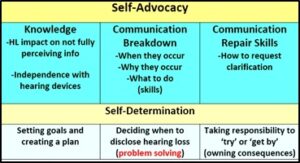
Components of self-advocacy and self-determination for students with hearing loss. Image courtesy of Supporting Success for Children with Hearing Loss.
Self-Advocacy
- What does it mean to have a hearing loss?
- Why do I have problems understanding (related to hearing loss and language issues)?
- How does my hearing loss affect me (school, socially)?
- When do I have problems understanding what people say?
- How important are my hearing devices?
- How do I know when my hearing devices are not working?
- What should I do when they are not working?
- What can I do when I know I have not heard what was said (specific self-advocacy & communication repair strategies)?
Self-Determination
- How much am I willing to have the hearing loss impact how well I do in school (planning/future goals)?
- When is it critical for me to disclose my hearing loss (problem-solving)?
- What are my legal rights to access, supports, and services?
From the US Office of Civil Rights:
We need to encourage students to understand their disability.
- They need to know the functional limitations that result from their disability.
- Understand their strengths and weaknesses. Be able to explain their disability to others.
- Be able to discuss their difficulties in the past and what has helped them overcome such problems.
- This should include specific adjustments or strategies that might work in a specific situation.
- They must practice explaining their disability, as well as why they need certain accommodations, supports, or services.
U.S. Department of Education, Office for Civil Rights, Transition of Students With Disabilities to Postsecondary Education: A Guide for High School Educators, Washington, D.C., 2007
Teaching Self-Advocacy
He does not know what he did not hear.
This reality underlies the requirement to teach self-advocacy, specifically teaching the student about what he does hear, what he does not hear, under what conditions, and how to use situational awareness to recognize when he likely missed information.
Image Credit: alexmillos / Stock Photo
Some knowledge of hearing loss teaching and assessment resources:
- Advocacy in Action Self-Advocacy Curriculum
- Audiology Self-Advocacy Checklist – Elementary School, Middle School, High School
- Building Skills for Success in the Fast-Paced Classroom
- ELFLing
- Monkey Talk Self-Advocacy Game
- Phonak Guide to Access Planning
- Recorded Functional Listening Evaluation Using Sentences Functional Listening Evaluation (FLE)
- Steps to Success: Sequence of Skills for Students who are Deaf/Hard of Hearing
Teaching Hearing Device Use and Troubleshooting
Some knowledge of hearing device use, teaching, and assessment resources:
- Race to the Brain Game
- Advocacy in Action Self-Advocacy Curriculum
- Building Skills for Independence in the Mainstream
- SEAM – Student Expectations for Advocacy & Monitoring Listening and Hearing Technology (PDF)
- Steps to Success: Scope and Sequence of Skills for Students who are Deaf/Hard of Hearing
Teaching Self-Advocacy Strategies
Some knowledge of self-advocacy skills, teaching, and assessment resources:
- Advocacy in Action Self-Advocacy Curriculum
- Building Skills for Independence in the Mainstream
- Building Skills for Success in the Fast-Paced Classroom
- COACH: Self-Advocacy & Transition Skills for Secondary Students who are Deaf/Hard of Hearing
- Guide to Self-Advocacy Skill Development: Suggestions for Sequence of Skill Attainment (PDF)
- Phonak Guide to Access Planning
- SCRIPT 2nd Ed: Student Communication Repair Inventory & Practical Training
- Steps to Success: Scope and Sequence of Skills for Students who are Deaf/Hard of Hearing
- What’s the Problem Game
Success in the general education setting requires ongoing instruction in self-advocacy skills needs, including hearing device independence for students who are hard of hearing, as part of the IEP or 504 Plan.
Frequently Asked Questions: Self-Advocacy as a Stand-Alone IEP Service
What does “self-advocacy as a stand-alone service” mean for DHH students?
A stand-alone service means that self-advocacy is treated as direct, systematic instruction by a specialized professional (like a Teacher of the Deaf or Educational Audiologist), rather than a passive accommodation listed on a document. It explicitly teaches deaf and hard-of-hearing (DHH) students to recognize when a communication breakdown occurs and deploy a strategy to fix it.
The Core Reality: Students do not know what they didn’t hear simply because they didn’t hear it. Accommodations like preferential seating or FM systems cannot close 100% of auditory communication gaps.
If a student gets good grades, do they still qualify for self-advocacy services?
Yes, absolutely. A common administrative misconception is that a student with high marks does not require specialized service hours. However, academic grades do not measure the following:
- Listening Fatigue: The extreme cognitive exhaustion a student experiences from straining to decode fragmented speech all day.
- Incidental Learning Loss: Missing the casual classroom peer interactions, whispered instructions, and back-and-forth discussions that drive social-emotional vocabulary.
- Lack of Independence: A student may earn an ‘A’ only because an adult is constantly managing their environment, which leaves them unprepared for adulthood.
Is self-advocacy instruction recognized under the Expanded Core Curriculum (ECC)?
Yes. For students who are deaf or hard of hearing, self-advocacy is a foundational pillar of the Expanded Core Curriculum (ECC). Because these specialized access skills are not taught in the general education curriculum, IDEA teams use the ECC framework to justify direct, stand-alone instructional minutes on the IEP service grid.
What is the operational difference between self-advocacy and self-determination?
While often used interchangeably, they represent two distinct levels of student autonomy:
- Self-Advocacy (The Action): The immediate ability to explain one’s hearing loss, manage personal technology, and request a communication repair (e.g., “Can you rephrase that? I missed the last step.”)
- Self-Determination (The Big Picture): The broader framework of life planning, goal setting, legal rights disclosure under the ADA, and long-term problem-solving for postsecondary transition.
At what age should direct instruction begin?
- Foundational Skill Building:
- Preschool to Grade 4 (Ages 3-10).
- Focus is on immediate environmental awareness. Students learn to identify their hearing devices, recognize basic troubleshooting issues (like a dead battery), and notice when background noise interferes with their listening.
- Situational Triage & Problem-Solving:
- Middle School (Ages 11-13).
- Focus shifts to active communication repair. Students practice explaining their specific hearing levels to rotating mainstream teachers, tracking their own accommodations, and requesting specific modifications during group work.
- Transition & Self-Determination:
- High School & Beyond (Ages 14+).
- Focus pivots to long-term legal and secondary transition planning. Students learn their legal rights under the Americans with Disabilities Act (ADA) and Section 504, practice formal disability disclosure, and manage their own transition meetings.
Additional Resources:
Self-Advocacy Apps
Self-Advocacy Skill Development is required in the Classroom
Self-Advocacy Skills for Students with Hearing Loss
The Ultimate Goal: Self-Determination
Teen Transition: A Necessary Part of Future Success
Click here to download the original article.
Originally published: Jan 2020
Last update: June 2026