Related Products
For Professionals
- Amplification
- Assessment of Student Skills, Challenges, Needs
- Early Childhood: Infants, Toddlers, Preschool
- Hearing Loss – Identification, Impact and Next Steps
- IDEA Law Summary Information
- Language and Speech Development Issues
- Legal Issues in Serving Children with Hearing Loss
- Listening (Auditory Skills) Development
- Planning to Meet Student Needs
- Self-Advocacy Skills for Students with Hearing Loss
- Self-Concept: How the Child with Hearing Loss Sees Himself
- Social Skills
- Speech Perception & Learning
Related Teacher Tools Takeout Items
Social Communication and Pragmatics in Children With Hearing Loss
Social communication and pragmatics are the skills that children use to understand conversations, interpret social signs, take turns speaking, and build relationships. 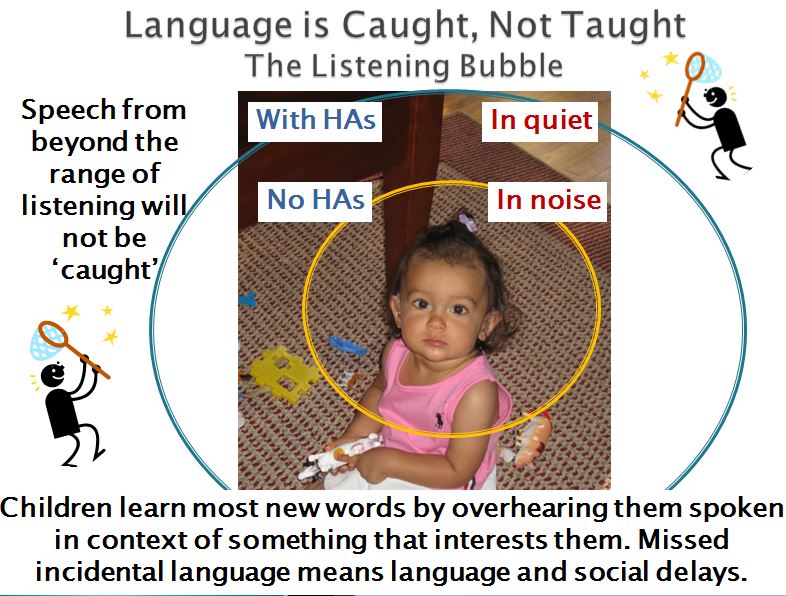 Children with hearing loss frequently require explicit guidance in acquiring these abilities since they miss many everyday discussions that naturally teach social communication.
When we think of the needs of children with hearing loss, it is widely known that they are very likely to have significant delays in language skills without early, effective, and meaningful interactions with those around them. Hearing loss is a distant sense that allows people to hear what is going on around them from a few inches to many feet away in some situations.
What is universal to children with hearing loss is that they have a reduced listening bubble, meaning that they are unable to overhear conversations going on around them beyond a few feet. Hearing aids have a very small microphone and pick up sound best in a quiet room when the speaker is within 3-6 feet. The distance between the ears of a child sitting on the floor near a standing parent is often further than 3-6 feet.
Along with fewer words learned, children with hearing loss are at high risk for not learning what typical hearing age mates know about social communication or pragmatic language use.
What Are Social Communication and Pragmatics?
Social communication and pragmatics are everyday communication abilities that children use to form connections, engage in discussions, recognize social signs, and communicate successfully in a variety of contexts. These abilities include knowing what to say and when to say it, interpreting facial emotions and body language, and adapting communication to diverse listeners. Because many opportunities for incidental learning are missing, we frequently teach these skills directly to children with hearing loss.
Summary of the Need for Children with Hearing Loss to Develop Pragmatics
Say and Do Positive Pragmatic Game Boards Fun Sheets
Say and Do Positive Pragmatic Game Boards & Fun Sheets help children learn to use appropriate social skills in everyday situations.
Pragmatic language skills are the most abstract and complex of all language skills. Even when the child has age-appropriate vocabulary and syntax (grammar) skills, they may not yet have learned how to use these skills in a socially appropriate manner for specific social purposes.
Young children with typical hearing acquire these skills rapidly between the ages of 3 and 4 and are able to use these pragmatic language skills with complex language.
Social Language Development Test – Elementary.
Children with hearing loss acquire these skills much more slowly even when provided early intervention and preschool services. Even at the age of 7, typical children with hearing loss have pragmatic language skills similar to a 3-year-old.
Without mastery of these skills, children will encounter significant challenges with literacy, written communication, and abstract conversational communication, all of which affect success in school and in getting along with peers. Being “socially awkward” and “not fitting in” all relate to pragmatic language skills and theory of mind.
The area of social cognition, or the ability to recognize emotional states in others, appears especially weak in children with hearing loss, with 7-year-olds having the ability to identify and explain feelings in a manner that is typical of a 3-year-old. This is why it is imperative to address social cognition specifically when a child has a hearing loss. (See intervention products below for intervention ideas).
Research Supporting Social Communication and Pragmatics
Research consistently shows that children with hearing loss are at greater risk for delays in social communication and pragmatics, even when vocabulary and grammar skills appear age-appropriate. The studies below explain why these differences occur and why early intervention is so important.
Developmental Research
A 2012 study asked parents to complete a 45-item checklist about how their child uses social communication skills. It was completed by parents of 109 children with typical hearing and parents of 126 children with hearing loss of all degrees between ages 2 and 7 years. For each of the 45 items, the parents had to decide if the child did not use any communication (not present), used no words (point, yank, or other preverbal gestures), used 1-3 words to express the communication in the item, or was able to use complex language.
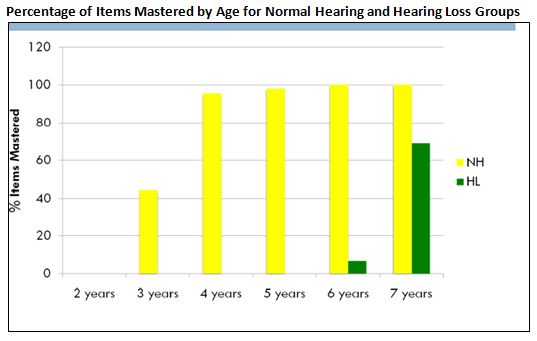 Results for the average number who were considered to have ‘mastered’ the item, meaning they used complex language (mastery = 75% of the age group being able to communicate using complex language)
- Average results for 109 children with typical hearing:
-
- 3 years = 20 of the 45 items
- 4 years = 43 of the 45 items
- 5 years = 44 of the 45 items
- 6 years = all of the items
-
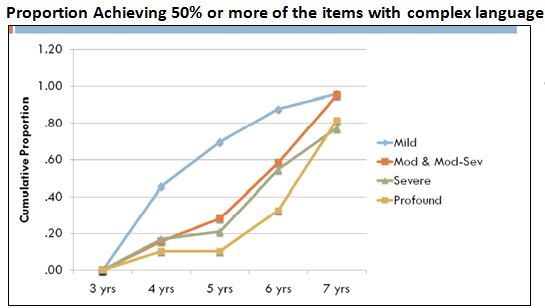 Average results for 126 children with hearing loss of all degrees:
-
- 3 years = 6 of the 45 items
- by 7 years = only 31 of the 45 items
-
Even children with “mild” degrees of hearing loss (26-40 dB) had substantial developmental delays in the area of social communication.
What Should We Do?
Social Language Development Test – Elementary
Assess specifically in the area of pragmatics. With 80% or more children with hearing loss being educated mainly in the mainstream, the ability to interact socially is crucial to their full participation in the classroom and acceptance by their peers.
In order to identify deficits in social communication, we must expand the scope of a comprehensive oral language evaluation to include daily pragmatic language behaviors. Most standard instruments used to assess language do NOT provide norm-referenced, valid, or reliable measures of social communication and therefore substantially miss or underestimate this important area of development (i.e., TOLD, OWLS).
Although the CELF-4 contains a Pragmatic Profile, it provides no normative data or standard scores (CELF-5 does have a teacher-completed Pragmatic Profile). The extensive CASL does tap into pragmatics, but it measures a student’s knowledge of pragmatics rather than actual use in school and social situations. It is up to the parents and professionals who specialize in supporting students with hearing loss to advocate for appropriate measures of pragmatic language use.
What Assessments Should be Used?
Assessing social communication and pragmatics requires more than just giving a single standardized test. Professionals often combine classroom observations, parent questionnaires, teacher feedback, structured activities, and formal assessment tools to create a comprehensive picture of a child’s communication strengths and areas for growth.
Observations and Informal Assessment
 For a hierarchy of expectations for the development of pragmatic language and Theory of Mind skills for ages 6 months through 7 years, access the Summary of Social Interaction (Pragmatic) Development / Theory of Mind handout.
We should use assessments that provide a valid, normative comparison between the student with hearing loss and his or her typical-hearing age peers. An internet search can provide a list of assessment instruments for clinicians to review. An expansive list will not be included on this site. The assessments vary greatly in validity, administration time, practicality, and expense. Below are recommendations:
Early Intervention through Preschool
The Language Use Inventory is completed by families for children ages 18-47 months. It has great norms and validity. The downside is the expense of the test and the length of the protocol that must be completed by families. If your agency will pay for it and your families will complete all of the pages, you will end up with a clear trajectory of pragmatic language learning as children transition from early intervention and eligibility for specialized instruction is considered. The reality is that the expense and parent completion really can be very significant issues.
Most growth of pragmatic language skills occurs between 30 and 48 months. We really need a snapshot as to whether a child seems to be ‘on target’ at the time of eligibility from early intervention and for planning/monitoring during preschool.
The Pragmatics Checklist, used in the study described above, has been included free for use by teachers/clinicians in their work with families of young children with hearing loss. A computer-fillable version of the Pragmatics Checklist is also available. It fits on one page and can be completed individually by the parents or as part of an interview dialogue with the early interventionist.
Social Communication Profiles
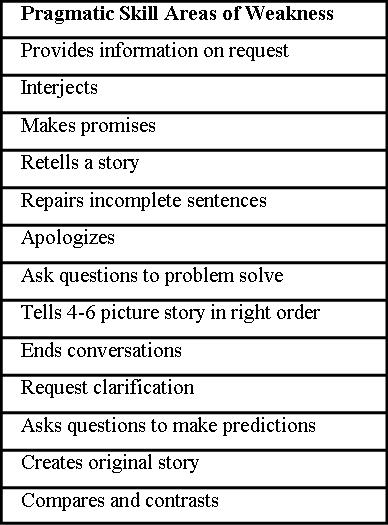
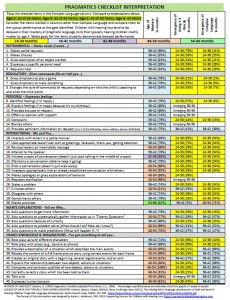
 The majority (75%) of children will be able to use complex language (full expressions of more than 3 words) per the following: Age 3: 20 of 45 items; Age 4: 43 of 45 items; Age 5: 44 of 45 items; Age 6: 45 items. Therefore, at transition, a child should have mastered 20 of the items using complex language. By entry into kindergarten, all items can be expected using complex language. Based on the results of the study, however, it is more likely that the child with hearing loss will exhibit challenges in some or most of the areas listed above as pragmatic skill areas of weakness. To provide further specificity of expected attainment of each of the skills, refer to the Pragmatics Checklist Interpretation, which provides the age of mastery in months (75% of the age group can perform using complex language) and when emergence using 1-3 words and using complex language can be expected.
RECOMMENDATION: The Pragmatics Checklist will be completed by families at least annually for all children with hearing loss ages 3 and 4, as part of planning for kindergarten readiness. Hierarchy of skill development for children ages 6 months to 8 years = Summary of Pragmatic Development + Theory of Mind (in Teacher Tools). Download the resource Teaching Your Child to Identify and Express Emotions and share it with families.
 Kindergarten through grade 2
Because the normative results for The Pragmatics Checklist included children with hearing loss up to age 7, it is appropriate for use through grade 2 as a parent-completed checklist. For ages 5, 6, and 7, it is desired for the parents to identify any of the items in which the child is able to use only a few words to express themselves, especially for the 17 items for which mastery is achieved between 48 and 54 months and the 1 item of mastery between 54 and 60 months. If the checklist has been completed by the families before and they have already checked that the earlier skills were mastered, it would be appropriate to just circle the items of interest (non-mastered and/or most age-appropriate). The interpretation guide shown is available with the fillable version of the Pragmatics Checklist.
PLSI
Pragmatic Language Skills Inventory.
Another, or additional, option that may be useful for monitoring development or program planning is the Checklist of Socio-Pragmatic Language Behaviors for Students with Sensory Impairment. This checklist was found on the internet, authorless, and was reformatted to fit on one page. It has been included free for use.
It includes many of the items from the Pragmatics Checklist in a manner more appropriate to school-age (K+) students. It is NOT normed or validated in any way but could be useful for planning or monitoring progress. If you developed this material, please contact me so your name can be specified as author.
SLDT-A
Social Language Development Test- Adolescent: Normative Update (SLDT-A: NU).
An excellent norm-referenced test to use is the Social Language Development Test, which can be administered starting at age 6. It has four subtests: making inferences, personal negotiations, multiple interpretations, and supporting peers. The test assesses students’ language-based responses to portrayed, peer-to-peer situations, which is unlike other tests that rely on observation forms, like the PLSI or PLOS.
There are tests specific to pragmatic language development that are appropriate starting at kindergarten age; however, expense and time commitment to complete should be carefully considered. Regardless of the instrument, the person completing the checklist needs to be very, very familiar with the child’s behavior and what is typical for age peers.
RECOMMENDATION:
Every student with hearing loss should be tested for pragmatic language deficits. The 18 older age (4-5 years) items of the Pragmatics Checklist can be completed as a screening measure by families for children with hearing loss ages 5, 6, and 7 (kindergarten through grade 2) prior to school entry or in the first couple of weeks of school. Once the classroom teacher has observed the student for 6 weeks or longer, the PLSI can be given to determine pragmatic language behavior issues. If a child is identified as having pragmatic language behavior issues in the classroom, the SLDT can be given to define the pragmatic language deficit. In addition, the teacher of the deaf/hard of hearing can consider the social communication skills represented on the Checklist of Socio-Pragmatic Language Behaviors for Students with Sensory Impairment for student planning and monitoring of progress. Share Improving Your Child’s Social Skills with families.
Grades 3 – 12
Again, there are tests that tap into pragmatic skill development for this age group (refer to list of assessment instruments). Most students with hearing loss are educated in the regular education mainstream classroom and have a classroom teacher who has observed their behavior over the course of many days and many situations. To initially explore pragmatic language skills, what seems most practical to obtain a snapshot as to whether a student seems to be ‘on target’ is a checklist that can be quickly completed by the classroom teacher and is also a valid measure of the student’s use of spoken language in school and social situations. The Pragmatic Language Skills Inventory (PLSI) has 45 items for the teacher to complete for students ages 5.0 – 12.11 years. Cut-off scores are provided for determining whether the student exhibits characteristics of a pragmatic language disorder. Guidelines are provided to assist the examiner in interpreting the results.
RECOMMENDATION: That the classroom teacher annually complete the Pragmatic Language Skills Inventory for children in grades 3-6. The Social Language Development Test can be used to further diagnose the pragmatic language deficit that has been identified by these teacher checklists. An increasing number of students with hearing loss are not being identified as eligible at school age, using a standard battery of language assessments. The results can also be used to support the referral of a student with hearing loss for educational assessment who was found to be previously ineligible. As part of that assessment, an instrument specific to evaluating pragmatic language and a valid comparison of results to normative performance can/should be performed.
Planning and Intervention
Planning: A PDF of a 2012 PowerPoint presentation on Pragmatic Puzzle PPT_ Practical Solutions for Evaluation and Treatment – Fleckenstein, Mary Michelle, presents an overview of pragmatic language, choosing tests to determine pragmatic disorders, report writing for pragmatic disorders (includes a detailed example), samples of goal writing, and a summary of intervention tools available.
Strategies to Build Social Communication and Pragmatics
- Understanding Theory of Mind in Deaf and Hard of Hearing Individuals: Insights from Dr. Carol Westby and Dr. Tiffany Hutchins
- Sandwich Scramble
One resource that suggests intervention for pragmatic language development, especially for young children, is available for consideration (The Missing Link in Language Development of Deaf and Hard of Hearing Children: Pragmatic Language Development).
An interesting British study researched the effectiveness of different interventions for children aged 6-10 years with pragmatic language deficits after 8 weeks of treatment (1 hour 3 times/week). Areas of intervention were:
a) pragmatic rules in discourse and conversation;
b) turn-taking;
c) meta-pragmatics;
d) social understanding and social role-playing;
e) formulation of conversation and narrative;
f) inferential understanding.
All children showed positive change, some more than others. Authors are careful to say that this intensive treatment schedule lacks evidence to show it is needed for every student; they do indicate that addressing the above areas will result in improvement in students’ social communication behavior.
Use this link to refer to another study that provides information on successful intervention.
There is a wide variety of intervention materials available for pragmatic communication learning, especially with the rise of students on the Autism Spectrum (see suggested tools at the end of the PowerPoint presentation mentioned under Planning).
Social Communication and Pragmatics: Key Takeaways
- Social communication and pragmatics help children build friendships and communicate successfully.
- Children with hearing loss often miss incidental learning opportunities that naturally develop these skills.
- Strong pragmatic language supports classroom learning, literacy, and peer relationships.
- Assessment should include observations, standardized tools, and family input.
- Early intervention improves long-term communication and social success.
Frequently Asked Questions: Social Communication and Pragmatics
What are social communication and pragmatics in children?
Social communication and pragmatics refer to the unwritten social rules for using language effectively during everyday interactions. These skills go beyond basic grammar or vocabulary and include knowing how to take turns in conversation, interpret non-verbal cues, stay on topic, adjust language for different listeners, and recognize what others are thinking or feeling.
Why do children with hearing loss struggle with pragmatic language skills?
Most typical-hearing children absorb pragmatic rules naturally through incidental listening, overhearing background chatter, adult discussions, and subtle social interactions within a 3-to-6-foot radius. Children with hearing loss miss these spontaneous learning opportunities due to a reduced “listening bubble.” Even when their vocabulary and grammar test at age-appropriate levels, they still require explicit instruction to master conversational nuances and social cues.
What are the key warning signs of pragmatic language difficulties?
Because a child may speak in complete sentences, pragmatic deficits can be easy to miss initially. Common behavioral red flags include:
- Frequently interrupting or failing to take turns during conversation.
- Struggling to stay on topic or abruptly switching subjects without context.
- Misunderstanding sarcasm, jokes, or figurative expressions.
- Dominating conversations without noticing when the listener is disengaged.
- Experiencing persistent social anxiety or difficulty making and keeping friends.
How are pragmatic language skills formally and informally assessed?
Standard language tests often fail to capture real-world social deficits because they take place in quiet, 1-on-1 settings. According to clinical recommendations, comprehensive evaluation requires a hierarchy of tools:
| Assessment Level | Recommended Tool / Method | What it Measures |
| Early Screening (Preschool–Grade 2) | Pragmatics Checklist or Pragmatic Language Observation Scale (PLSI) | Teacher/parent observation of real-world communication mastery across daily routines. |
| Standardized Testing (Elementary–High School) | Social Language Development Test (SLDT-A / SLDT-E) | Direct measurement of a student’s ability to make inferences, take perspectives, and solve social problems. |
| Comprehensive Profiling | CELF-4 Pragmatics Profile or teacher questionnaires | Evaluates ritualized greetings, non-verbal cues, and context-appropriate language usage. |
How can parents and teachers support pragmatic skill development?
To move beyond basic conversation rules, families and school teams can deploy this actionable three-step strategy:
- Practice Explicit Turn-Taking and Emotion Vocabulary:
- Home Environment.
- Use shared storybook reading and pretend play to pause and discuss characters’ feelings, intentions, and perspectives. Explicitly name emotional states to build non-verbal recognition.
- Structure Cooperative Group Interactions:
- Classroom Setup.
- Teachers can pair students intentionally during group work and enforce clear “one-speaker-at-a-time” rules. This removes chaotic background noise and gives the student a predictable framework to practice conversational turns.
- Teach Communication Repair Scripts:
- Targeted Repair.
- Equip the child with comfortable, matter-of-fact phrases to address conversational breakdowns (e.g., “I missed that last sentence; can you rephrase it for me?”).
What is the connection between pragmatics and the Theory of Mind?
Theory of Mind is the cognitive ability to understand that other people have thoughts, beliefs, and feelings that differ from one’s own. Strong social communication and pragmatics rely directly on Theory of Mind: a child must be able to infer what a listener already knows before deciding how much information to provide or how to adjust their tone in a conversation.
Additional Resources:
- Social Skills
- Building Your Child’s Self-Confidence: Guide for Children with Hearing Loss
- Key Factors in Language, Social, and Developmental Outcomes
- Self-Esteem and Fitting In: Supporting DHH Students
- Social Needs & “I hate my hearing aids.”
- Theory of Mind – Implications for Social Success
- Hearing Aid Rejection in Children
- Summer Camps for DHH Children
Continue Learning About Self-Confidence and Self-Concept
- How They See Themselves: Self-Concept in Children with Hearing Loss
- Self-Concept in Early Childhood
- Self-Concept in School-Age Children
- Self-Identity and Hearing Loss
- Building Self-Esteem and Addressing Issues of Fitting In
- Self-Advocacy Skills for Students with Hearing Loss
Information compiled by Karen L. Anderson, PhD, September 2013 for
Supporting Success for Children with Hearing Loss.
Last Update: July 2026