Related Products
For Professionals
- Amplification
- Assessment of Student Skills, Challenges, Needs
- Early Childhood: Infants, Toddlers, Preschool
- Hearing Loss – Identification, Impact and Next Steps
- IDEA Law Summary Information
- Language and Speech Development Issues
- Legal Issues in Serving Children with Hearing Loss
- Listening (Auditory Skills) Development
- Planning to Meet Student Needs
- Self-Advocacy Skills for Students with Hearing Loss
- Self-Concept: How the Child with Hearing Loss Sees Himself
- Social Skills
- Speech Perception & Learning
Related Teacher Tools Takeout Items
Captioned Instructional Videos for Students
Captioned instructional videos help students who are deaf or hard of hearing access lessons more easily. They also support many learners by making school videos clearer, easier to follow, and easier to review later.
What Are Captioned Instructional Videos?
Captioned instructional videos are educational videos that include synchronized text captions for spoken dialogue and audio information. These videos help deaf and hard-of-hearing students access classroom instruction, improve comprehension, and participate more fully in learning activities.
Benefits of Captioned Videos for Students With Hearing Loss
Include:
- improved comprehension
- vocabulary growth
- literacy support
- visual reinforcement
- reduced listening fatigue
- better classroom participation
Described and Captioned Instructional Video
Logo courtesy of the Described and Captioned Media Program (DCMP). © 2026 DCMP. All rights reserved. Used for informational purposes.
The Described and Captioned Media Program’s mission is to promote and provide equal access to communication and learning for students who are blind, visually impaired, deaf, hard of hearing, or deaf-blind. DCMP is funded by the U.S. Department of Education and administered by the National Association of the Deaf. There are no costs or fees associated with any DCMP services.
Media Center
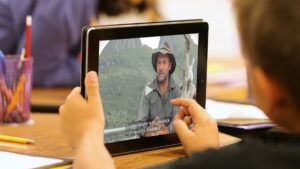
A student uses an accessible media tablet to watch a captioned educational video. (Image credit: Described and Captioned Media Program (DCMP))
DCMP provides a media center of thousands of accessible educational videos. We work with producers and distributors of educational media to provide described and captioned versions for family members and educators with early learners through Grade 12 students who are blind or deaf. Media items are available on demand and on DVD with return postage paid. All DCMP services are free to those who qualify. DCMP members can:
- Access thousands of educational videos that are captioned and described, including training for parents, teachers, and interpreters.
- Watch instantly on PCs, Roku, tablets, and smartphones. iOS users can download our free app from iTunes.
- Create student accounts to promote independent learning, with control over which videos students have access to.
- Access hundreds of posts on education, accessibility, and advocacy in our Learning Center.
- Stay up-to-date on news and recently added videos by subscribing to our monthly newsletter.
- Watch accessible television series such as The Magic School Bus, BizKids, Daniel Tiger, Plaza Sesamo, and Bill Nye.
Learning Center
DCMP provides accessibility information through posts in our Learning Center. Topics include captioning, description, laws pertaining to accessibility, assistive technology, and an array of other subjects that are relevant to parents, teachers, interpreters, school administrators, captioners, describers, and media producers and distributors.
eLearning Resources
Image credit: Described and Captioned Media Program (DCMP)
DCMP’s eLearning Resource page includes resources for teachers, professional and amateur captioners and describers, students in transition and their teachers, and ASL interpreters. CEUs are available for select resources.
eLearning Modules
DCMP has a variety of self-paced online learning modules, designed for both professionals and students. These modules are open to eLearners and full members. Select modules are pre-approved for RID and ACVREP credit.
Online Workshops
DCMP offers a variety of on-demand workshops for professionals working with students who are deaf, hard of hearing, blind, low vision, and deaf-blind. Full membership is required to register for most of these trainings. A few are open to eLearners as well. Workshops have been pre-approved for RID and ACVREP credit.
QuickClasses
QuickClasses are facilitated, asynchronous online classes for professionals working with students who are deaf, hard of hearing, blind, low-vision, or deaf-blind. QuickClasses are approved for RID and ACVREP credit. Full membership is required to register for these classes.
Gateway
DCMP’s Gateway provides for selectively searching across a clearinghouse of accessibility-related articles from partner sites, including the American Council of the Blind, Gallaudet University, PEPNet, National Consortium on Deaf-Blindness, and the National Dissemination Center for Children with Disabilities.
Guidelines for Describing and Captioning an Instructional Video
DCMP’s guidelines for making educational media accessible are available for anyone to use and indeed are utilized on all levels of video production, from broadcast content to educational video to teacher-created video.
FAQs About Captioned Instructional Videos
What are captioned instructional videos?
Captioned instructional videos are school videos with words on the screen that match the spoken words and important sounds. They help students who are deaf or hard of hearing follow along.
Why are captions important?
Captions help students see what is being said. They can make lessons easier to understand, reduce stress, and help students stay focused.
What is DCMP?
DCMP stands for the Described and Captioned Media Program. It is a free resource from the U.S. Department of Education that offers accessible educational videos.
Are captioned videos free?
Many captioned videos and DCMP resources are free for teachers, families, and students who qualify.
How do captioned videos help in class?
- Captioned videos help students:
- Understand lessons better.
- Learn new words.
- Follow along more easily.
- Stay engaged during class.
- Review information at their own pace.
Can students without hearing loss use captions too?
Yes. Captions can help many students, including:
- English learners.
- Students with listening problems.
- Students who learn better with visuals.
How can teachers use captioned videos?
Teachers can use them during:
- Whole-group lessons.
- Small groups.
- Independent work.
- Homework.
- Review time.
What is the difference between captions and transcripts?
Captions appear on the video as it plays. A transcript is the written text of the video that students can read separately.
What kinds of videos does DCMP offer?
DCMP offers many school videos on topics like:
- Reading.
- Math.
- Science.
- History.
- Health.
- Life skills.
Why do captioned videos improve accessibility?
Captioned videos give students equal access to spoken information. They help make learning more fair, clear, and inclusive.
Additional Captioned Instructional Video Resources:
What are 504 Plans? Accommodations for Students with Hearing Loss
Captioned Media to the Rescue!
Research Review – What do DHH Students Think About Captions
Online Learning Environments: Strategies for Mitigating Visual Fatigue and Split Attention in Times of Teacher Deficits
Originally Published: Oct. 2018
Last Updated: June 2026