Related Products
For Parents
Related Teacher Tools Takeout Items
Bullying and Teasing: Protecting Students with Hearing Loss
Communication barriers, misunderstandings, and social exclusion put students with hearing loss at higher risk for bullying and teasing. When adults know what to look for, they can intervene early on and support the student’s confidence and safety.
Did you know that October is National Bullying Prevention Month? It’s the perfect time to refresh our efforts in preventing and designing strategies to support our students.
What is Bullying and Teasing?
Bullying and teasing can influence the emotional, social, and academic lives of students with hearing loss long-term. Research shows these students face much higher rates of bullying than their hearing peers because of differences in communication, hearing technology, and social isolation. Prevention involves parents, teachers, and students.
What is the difference between bullying and teasing?
Teasing can sometimes be playful when everyone is comfortable, but bullying is intentional, repeated behavior that causes harm or fear. If a child feels threatened, excluded, or repeatedly targeted, it’s important to take the situation seriously. (Find a more in-depth guide on Bullying and Students with Hearing Loss: What Parents and Educators Need to Know.)
Why Bullying and Teasing Affect Students with Hearing Loss

Students interacting in a classroom setting. Photo credit: iStockphoto.
Gallaudet researchers found that 812 deaf and hard-of-hearing students in eleven U.S. schools reported instances of bullying at rates 2-3 times higher than those reported by hearing students. It is obvious that bullying is a serious problem. What is not always so clear is how parents, teachers, and deaf/hard-of-hearing students can work together to resolve it.
The incidence of bullying in the deaf or hard-of-hearing student population is a significant, even startling, reality. A 2018 study1 found that adolescents with hearing loss endured a significantly higher incidence of bullying versus the general population (50.0% vs. 28.0%), particularly for exclusion (26.3% vs. 4.7%) and coercion (17.5% vs. 3.6%). Children younger than 12 years with hearing loss reported lower rates of bullying (38.7%) than adolescents with HL, but rates did not differ significantly.
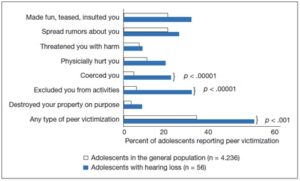
Comparison of peer victimization rates between adolescents in the general population and adolescents with hearing loss. Image courtesy of Dr. Andrea Warner-Czyz, originally published in the study “Peer Victimization of Children with Hearing Loss.”
“I thought more children and adolescents with hearing loss would report getting picked on, but I did not expect the rates to be twice as high as the general population,” said Dr. Andrea Warner-Czyz, study author.
In 20162, the story of a deaf high school student in Nebraska was reported on television news. Students had taken his backpack during a lunch period and dumped it in a toilet. Contained inside were his tablet, school supplies, homework, debit card, and his cochlear implant. The student, Alexis Hernandez, reported, “Those students think it’s ok to bully a deaf student, but it’s not. It’s not OK to bully someone who is disabled, deaf, or hard of hearing. Or anyone for that matter.”
Another study3 found that students who had lower language abilities were more vulnerable to victimization if they lacked understanding of their own emotions and levels of anger, sadness, and fear. As students with hearing loss have a greater risk for difficulty in being able to identify and describe emotional states4, recognizing that these challenges may contribute to victimization has important implications for intervention.
Bullying can be5:

: An anti-bullying graphic showcasing multiple forms of peer-to-peer mistreatment, highlighting the importance of recognizing different types of bullying and teasing in school environments. (Credit: U.S. Air Force Graphic by Jan Kays)
- Verbal: name-calling, insulting, teasing, ridiculing
- Emotional/indirect: ignoring or deliberately excluding, spreading rumors or nasty stories, turning friends against the child, laughing at them or talking about them behind their back, taking, hiding, or damaging their personal belongings, drawing unkind pictures of the child, using a feature of the child’s disability to bully them, e.g., deliberately making loud noises near a deaf child who is known to find loud noises unpleasant, creeping up on them from behind to scare them, deliberately making a noise when the teacher is giving instructions.
- Physical: any physical contact that would hurt, such as hitting, kicking, pinching, pushing, shoving, tripping up, or pulling out hearing aids.
- Manipulation/controlling behavior: using the child’s vulnerability as a way of controlling them or making them do something the bully wants them to do.
- Cyberbullying: using electronic media (internet, mobile phones) to bully someone. This includes bullying through text messages, instant messaging, email, chat forums, online games, and social networking websites.
Warning Signs of Bullying and Teasing
- Increased anxiety
- Depression
- School avoidance
- Reduced self-esteem
- Social withdrawal
- Lower academic performance
- Technology rejection
- Loss of communication confidence
Helping Students with Bullying and Teasing
Once we recognize what forms the behavior takes, what possible solutions are available for our students who are vulnerable?
Incorporate routine screening for bullying via direct questions6:
- Ask the child about friends. A response of “none” or “few friends” deserves additional prompting (Why do you think that is?).
- Inquire if the child avoids going to school and request more information on the assistance the child has accessed.
- Ask the child directly if he or she has experienced bullying. If the child answers “yes,” ask follow-up questions and refer the child to school and community resources.
Address developing skills to reduce victimization in the student’s IEP6:
Fotolia / Adobe Stock
Issues related to peer victimization can also be included in individualized education plans or 504 plans. For example, educational plans can specify informing teachers and classmates about hearing loss. Plans can also include a safe environment statement designating a “home base” where a student can go when feeling unsafe and/or a “safe person” with whom a student can discuss difficult situations. Additionally, education plans could include strategies to reduce vulnerability and improve response to bullying by targeting social pragmatic skills (e.g., taking turns and asking questions; reading facial expressions and body language) via one-on-one instruction, role playing, or social stories. Organizing a social skills group can help children develop social competencies in a supportive environment. Clinicians can also help patients address assertiveness and/or self-advocacy, with specific training to identify and report bullying, say “no” to stop the situation, and request assistance from a trusted source.
Helping Students Respond to Bullying and Teasing
What teachers can do:
Provide ongoing education to keep students aware that the bullying they may be experiencing or doing to others is unacceptable. Give your students a safe and open communication pathway for reporting incidents of bullying. Recognize that bullying will most often happen when you are not watching. In the lunchroom, the bathrooms, the playground, and the hallways. Just because you did not see it, does not mean it did not happen!
- Be a listener.
- Be supportive.
- Report incidents to your school administration as promptly as possible.
What parents can do:
Talk to your child about feelings openly and often. They need to know that when things go wrong, you will be there to support them. Stay closely involved with school administrators and teachers. Does the staff understand about hearing loss? Really understand?
Cyberbullying and Teasing: What Families Need to Know
This form of bullying may be the most insidious and dangerous of all. While our deaf and hard-of-hearing students find invaluable and positive connections online, the potential for negative interactions has increased disproportionately.
How can we be proactive about cyberbullying? By being fully aware of what websites are being used. If we, as adults, continue to make excuses about our lack of skill or disdain for social media, we are inadvertently providing limitless opportunities for our children to be vulnerable to cyberbullying.
Recognize, React, and Raise Awareness
October is dedicated to Bullying Prevention, but teachers and parents of deaf and hard-of-hearing children are fully aware that the need to protect vulnerable students is ongoing. Find a wealth of resources to stop bullying in your family, classroom, or school on the following websites.
Resources for Teachers and Parents
- http://www.nea.org/tools/lessons/teaching-students-to-prevent-bullying
- https://stompoutbullying.org/get-help/about-bullying-and-cyberbullying
- https://www.stopbullying.gov/cyberbullying/digital-awareness-for-parents
- https://www.google.com/search?q=https://www.pacer.org/bullying/resources/classroom/students-with-solutions/
- Kraizer, S. (2007). 10 Days to a Bully-Proof Child. Marlowe & Co., New York. https://www.amazon.com/10-Days-Bully-Proof-Child-Confidence/dp/1569242534
Frequently Asked Questions: Bullying and Teasing Dynamics in Deaf Education
What does the research show about bullying and teasing for deaf students?
Data from Gallaudet researchers reveal that deaf and hard-of-hearing students report instances of bullying and teasing at rates 2 to 3 times higher than typical-hearing students. Adolescents with hearing loss also experience a vastly disproportionate rate of social isolation, relational manipulation, and passive peer exclusion in mainstream environments.
How can adults classify and identify the different types of peer victimization?
Peer victimization isn’t always overt or physical. School teams must recognize the three distinct ways bullying and teasing manifest in a school setting:
| Type of Victimization | How It Manifests in School | Hidden Impact on the Student |
| Physical Bullying | Hitting, pushing, shoving, tripping, or physically pulling out hearing devices. | Physical danger and direct damage to expensive, essential audiological technology. |
| Emotional / Indirect | Deliberately excluding, spreading rumors, laughing at them, or hiding their belongings. | Relational isolation, lower self-esteem, and severe school avoidance. |
| Manipulation & Control | Exploiting a student’s communication vulnerability to force compliance or mock errors. | Internalized helplessness and a complete lack of control over their social environment. |
What routine screening sequence should professionals use to detect bullying?
Because DHH students frequently hide their distress out of social shame, educators, speech-language pathologists, and parents should use this systematic, direct approach during check-ins:
- Prompt for Friendships:
- Assess Social Networks.
- Ask the child directly about their peer interactions. If their response is “none” or “I have few friends,” use extra prompting to explore why they feel that is the case.
- Inquire About School Avoidance:
- Identify Behavioral Resistance.
- Look closely at school attendance patterns. Ask if they actively avoid going to school or feel anxious entering specific, unstructured areas like the lunchroom or playground.
- Ask the Bullying Question Directly:
- Direct Investigation.
- Ask the child directly if he or she has experienced targeted bullying or teasing. If they answer “yes,” immediately document the details and refer them to supportive school resources.
Why does cyberbullying present a unique danger for DHH youth?
While online spaces offer invaluable peer connections for deaf youth, digital bullying can be incredibly insidious. Because online communication relies heavily on fast-paced text, multi-person group chats, or uncaptioned video snippets, bullies can easily isolate a DHH student, leave them out of online groups, or spread rumors behind their back with zero physical visibility or adult oversight.
How can school teams build assertiveness against bullying and teasing?
Rather than just hoping it won’t happen, speech-language pathologists, clinicians, and teachers should establish dedicated social skills groups. These groups can explicitly teach and practice three core target behaviors:
- Identify and Report: Recognizing the exact point where an innocent joke crosses the line into targeted bullying and harassment.
- Set Clear Boundaries: Proactively practice saying a clear, matter-of-fact, calm “no” to stop the situation in its tracks without showing emotional vulnerability.
- Request Assistance: Confidently approach a trusted, pre-designated adult ally to secure immediate help when a communication breakdown is weaponized by a peer.
References
- Warner-Czyz, A. D., et al. (2018). Effect of hearing loss on peer victimization in school-age children. Exceptional Children. https://medicalxpress.com/news/2018-04-children-loss-bullying.html . Download from: https://successforkidswithhearingloss.com/wp-content/uploads/2019/09/Children-with-hearing-loss-face-more-bullying-2018.pdf
- 2016 news: https://www.newschannel5.com/news/national/burke-high-school-investigating-bullying-incident-after-it-goes-viral
- Van den Bedem, N.P., et al (2018). Victimization, bullying, and emotional competence: Longitudinal associations in (Pre)Adolescents with and without developmental language disorder, Journal of Speech, Language, and Hearing Research, 61, 2028-2044.
- Goberis, D., Beams, D., Daples, M., Abrisch, A., Baca, R. & Yoshinaga-Itano, C. (2012). The Missing Link in Language Development of Deaf and Hard of Hearing Children: Pragmatic Language Development. Seminars in Speech and Language, (2012), 33:4, 297-309.
- Bullying Advice for Parents of Deaf Children. National Deaf Children’s Society in the UK. Download from: https://successforkidswithhearingloss.com/wp-content/uploads/2019/09/Bullying-Advice-for-Parents-of-Deaf-Children-NDCS-UK.pdf
- Warner-Czyz, A. D. (2018). Peer victimization of children with hearing loss. The Hearing Journal, October. Download from: https://successforkidswithhearingloss.com/wp-content/uploads/2019/09/Peer_Victimization_of_Children_with_Hearing_Loss.4.pdf
Additional Bullying and Students with Hearing Loss Resources:
Bullying and Students with Hearing Loss: What Parents and Educators Need to Know
Self-Concept: How the Child with Hearing Loss Sees Himself
Self-Concept: Infants, Toddlers, and Preschoolers
Self-Concept: School-Age Children with Hearing Loss
Self-Concept: Assessment & Strategies for Adolescence
Supporting Self-Concept in Students with Hearing Loss: 3 Go-To Ideas
Self-Identity and Hearing Loss
Addressing Self-Esteem and Issues of Fitting In
Teens and the Price to Pass as ‘Normal’
Reducing the Impact of Stigma and Teasing
Supporting Mental Health of Deaf and Hard-of-Hearing Students in the School Setting
What I Wish My Educators Had Known: 20 Tips from Mainstream Deaf and Hard-of-Hearing (DHH) Individuals
Click Here to Download this Article
Originally published: Oct. 2019
Last updated: June 2026