Related Products
For Professionals
- Amplification
- Assessment of Student Skills, Challenges, Needs
- Early Childhood: Infants, Toddlers, Preschool
- Hearing Loss – Identification, Impact and Next Steps
- IDEA Law Summary Information
- Language and Speech Development Issues
- Legal Issues in Serving Children with Hearing Loss
- Listening (Auditory Skills) Development
- Planning to Meet Student Needs
- Self-Advocacy Skills for Students with Hearing Loss
- Self-Concept: How the Child with Hearing Loss Sees Himself
- Social Skills
- Speech Perception & Learning
Related Teacher Tools Takeout Items
Bridging Literacy Models: Comparing Scarborough’s Reading Rope and the Deaf Reading Rope

The integration of word recognition and language comprehension helps to facilitate the skills necessary for reading skill development. Access to language and sound plays an integral part to traditional learning in this model. How then, do teachers address phonological awareness and sound based components of the reading rope, when there is little to no sound access? The Deaf Reading Rope, introduced by Nathan E. Harrison in 2023, intertwines strands of Scarborough’s reading rope with a new representation of the integration of sub-skills necessary for proficient reading, that caters to different linguistic and sensory experiences.
Scarborough’s Reading Rope: A Foundation for Understanding Reading Development
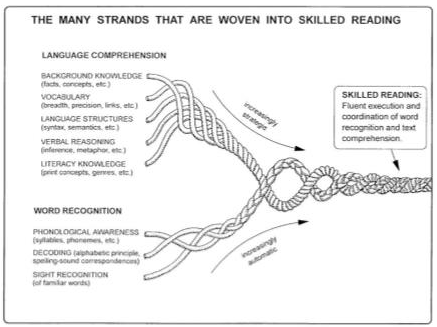
Developed by Dr. Hollis Scarborough in 2001, Scarborough’s Reading Rope illustrates how skilled reading is the result of intertwined language comprehension and word recognition skills. The model comprises two main strands:
Language Comprehension: This upper strand includes background knowledge, vocabulary, language structures, verbal reasoning, and literacy knowledge.
Word Recognition: The lower strand encompasses phonological awareness, decoding, and sight recognition of familiar words.
As these strands become increasingly automatic and strategic through instruction and practice, they weave together to produce fluent and skilled reading .
The Deaf Reading Rope: Tailoring Literacy Models for Deaf and Hard of Hearing Learners
Developed by Dr. Hollis Scarborough in 2001, Scarborough’s Reading Rope illustrates how skilled reading is the result of intertwined language comprehension and word recognition skills. The model comprises two main strands:
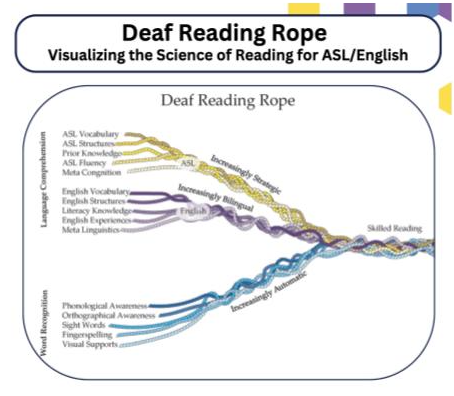
Recognizing that traditional reading models may not fully address the variety of experiences for deaf and hard of hearing (DHH) learners, Nathan E. Harrison introduced the Deaf Reading Rope in 2023. This model adapts the original framework to better represent the bilingual and bimodal nature of DHH students’ language acquisition, particularly those who use American Sign Language (ASL) and English.
The Deaf Reading Rope consists of three primary strands:
ASL Language Comprehension: Acknowledging ASL as a complete and natural language, this strand emphasizes the importance of ASL proficiency in developing reading skills.
1. English Language Comprehension: This strand focuses on the understanding of English, which may be acquired through reading and writing, especially for students who primarily use ASL.
2. Word Recognition: Similar to Scarborough’s model, this strand includes decoding and sight recognition but is adapted to consider the visual nature of ASL and the different pathways DHH students may use to recognize written words
By integrating these strands, the Deaf Reading Rope provides a more inclusive framework that reflects the linguistic realities of DHH learners.
Comparative Analysis: Aligning and Differentiating the Models
While both models aim to dissect the components of skilled reading, their applications differ based on the target populations:
Language Modalities: Scarborough’s model is primarily designed for learners acquiring reading skills through spoken language, whereas the Deaf Reading Rope incorporates both signed and written languages, acknowledging the bilingual nature of DHH learners.
● Instructional Implications: Educators using Scarborough’s model may focus on phonological awareness and decoding strategies suited for hearing students. In contrast, the Deaf Reading Rope suggests instructional strategies that leverage ASL proficiency to support English literacy, such as using ASL storytelling to build background knowledge and vocabulary.
● Cultural and Linguistic Recognition: The Deaf Reading Rope explicitly recognizes ASL as a foundational language, promoting a culturally responsive approach to literacy that validates the linguistic identity of DHH students.
Visual Representations
Visual aids are integral to both models, providing educators with clear frameworks for instruction.
● Deaf Reading Rope: Often illustrated with distinct strands for ASL and English language comprehension, along with word recognition, emphasizing the bilingual and bimodal aspects of DHH literacy development.
● Scarborough’s Reading Rope: Typically depicted as a rope with intertwining strands representing the various components of language comprehension and word recognition.
Reference:
● Scarborough, H. S. (2001). Connecting early language and literacy to later reading (dis)abilities: Evidence, theory, and practice. In S. B. Neuman & D. K. Dickinson (Eds.), Handbook of Early Literacy Research (pp. 97–110). Guilford Press. Landmark Outreach
● Harrison, N. E. (2023). Deaf Reading Rope: Visualizing the Science of Reading for ASL/English. Retrieved from https://osf.io/d96jx