Related Products
For Professionals
- Amplification
- Assessment of Student Skills, Challenges, Needs
- Early Childhood: Infants, Toddlers, Preschool
- Hearing Loss – Identification, Impact and Next Steps
- IDEA Law Summary Information
- Language and Speech Development Issues
- Legal Issues in Serving Children with Hearing Loss
- Listening (Auditory Skills) Development
- Planning to Meet Student Needs
- Self-Advocacy Skills for Students with Hearing Loss
- Self-Concept: How the Child with Hearing Loss Sees Himself
- Social Skills
- Speech Perception & Learning
Related Teacher Tools Takeout Items
The Gap Between Teacher of the Deaf Training and Early Intervention Practice
Early Intervention

Early intervention with newly identified infants and their families is a specialty area within deaf education. Not only does it draw upon knowledge of deaf education best practices, it requires a whole set of additional knowledge and skills that most university preparation programs simply don’t cover. This isn’t a personal gap, this is a systemic one.
You’re Not Alone and the Research Agrees With You
The gap between Teacher of the Deaf and Hard of Hearing preparation and early intervention practice isn’t something a few teachers quietly experience. It is documented in peer-reviewed research, national policy reports, and the position statements of major professional organizations.
Maryilyn Sass-Lehrer at Gallaudet University, one of the leading researchers in early intervention for deaf and hard of hearing children, has written that the growth of newborn hearing screening has created a surge in infants needing services, while the pipeline of specialists prepared to serve them has not kept pace. She notes that some families end up with providers “who do not understand the complex issues related to being deaf and who may inadvertently misguide” them – not out of carelessness, but out of a system that hasn’t prepared them. (Sass-Lehrer, Early Beginnings, Galludet/Laurent Clerc National Deaf Education Center)
A 2016 study published by the National Institutes of Health found that even among credentialed teachers of the deaf and hard of hearing working in early intervention, preparation levels were only weakly to moderately correlated with comfort providing specific early intervention (EI) skills particularly around supporting spoken language development in infants. In other words: a credential is not the same as preparation. (Factors Affecting Early Services for Children Who Are Hard of Hearing, PMC 4766183)
Dr. Harold Johnson, Emeritus Professor at Kent State University, said it plainly: “There is a gap between the preparation that deaf education preservice teachers receive and the roles thay are expected to fill.” (Hands and Voices, Fall 2019)
And the pipeline itself is shrinking. A 2025 study in the Journal of Deaf Studies and Deaf Education confirmed that teacher of the deaf and hard of hearing preparation programs have continued to close even as demand for qualified teachers grows. (Scott, Pagliaro, et al., 2025)
What Makes Infant and Toddler EI Different From What You Were Trained For

Happy loving family. mother and child girl playing, kissing and hugging at home
Before looking at what to do, it helps to name exactly what the early intervention context requires that may not have been part of your training. This is not a list of what you may have done wrong; it is a map of the terrain.
- Your primary “student” is the family, not the child. In EI, you are working to build caregiver capacity. Your role is to help parents understand their child’s hearing difference, become confident communication partners, and learn how to weave language-rich interaction into everyday routines. This requires coaching skills, empathy for families in crisis, and comfort with a much more collaborative dynamic than the typical teacher-student relationship.
- The framework is family-centered, not child-centered. Under IDEA Part C, EI services are built around an Individualized Family Service Plan (IFSP) not an Individual Education Plan (IEP). The family sets the priorities. Your job is to support their goals within the rhythm of their daily life. This is a fundamentally different orientation than school-based services, and it takes intentional adjustment.
- You need 0-3 developmental knowledge. Infant language acquisition, attachment and bonding, parent-infant interaction, and developmental red flags in babies are foundational to EI work. These topics are rarely covered in depth in K-12 TODHH preparation programs, and they matter enormously when you’re sitting across from a four-month-old and her parents.
- Communication modality decisions are immediate and emotionally loaded. Families of newly identified babies are often making decisions about spoken language, ASL, or a bilingual approach within weeks of diagnosis, and sometimes with little information and a great deal of pressure from muliple directions. You need to be prepared to offer balanced, unbiased information across communication approaches, regardless of your own training emphasis.
- The home is your classroom. EI is typically delivered in the home or other natural environments. That changes everything: how you structure a visit, how you observe and coach in real time, how you embed learning into feeding, bathtime, and play. This is not a pullout session at a table with materials you prepared in advance.
What “Qualified” Actually Means for This Work
Several national organizations have issued clear guidance on what early intervention providers for DHH infants should know and be able to do. It is worth reading this list not as a judgment, but as an honest picture of what these families need.
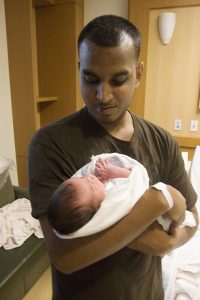 According to the National Association of the Deaf (NAD), drawing on the Joint Committee on Infant Hearing (JCIH), early interventionists serving DHH infants should be able to:
- Provide families with information specific to their child’s hearing difference
- Offer information about family activities that facilitate language development
- Share information about the full range of communication approaches used by deaf and hard of hearing people
- Connect families to peer and language models – including Deaf community resources
- Help families understand their infant’s strengths and needs
- Promote the family’s confidence and ability to advocate for their child
- Build family support systems
The JCIH also specifies that all EI providers for this poulation should have training and expertise in auditory, speech, and language development across both spoken and signed language as well as child development in the 0-3 range. (JCIH Position Statement, 2007; Supplement 2013)
Practical Steps If You’re In This Situation Right Now
If you have a newly identified infant on your caseload and you’re feeling the weight of that responsibility, here is a grounded path forward. You don’t have to know everything before you walk in the door, but you do deserve support, and there are real resouces available.
- Name the gap kindly, clearly, and in writing. You are not refusing the work. You are being a responsible professional. Let your supervisor know that you want to serve this family well. That requires EI-specific training and support. Request mentoring, professional development, or consultation as part of taking on the caseload. Document the conversation. This protects you and the family.
- Connect with your state EHDI program. Every state has an Early Hearing Detection and Intervention (EHDI) program. Many offer training, technical assistance, and connections to EI specialists. Find yours through the National Center for hearing Assessment and Management (NCHAM) – an invaluable hub for everything related to early intervention and DHH children.
- Get grounded in the SKI-HI Model. The SKI-HI curriculum, developed at Utah State University, is one of the most widely used evidence-based farmeworks for home-based EI with deaf and hard of hearing children. It is family-centered, communication-approach neutral, and practical. Available through NCHAM.
- Reach out to your state’s Hands & Voices chapter. Hands & Voices is a parent-led organization with state chapters across the country. Their Advocate Support Training (ASTra) program and regional networks can connect your with family support coordinators, Deaf mentors, and experienced EI professionals in your area.
- Find a mentor, not just a manual. Ask your state school for the deaf, regional DHH programs, or early intervention coordinators whether there is an experienced EI specialist who could serve as a consultant or mentor. Someone who has actually sat in living rooms with newly identified families brings a kind of wisdom no textbook can fully capture.
- Consider specialized graduate-level training. Gallaudet University offers a graduate certificate program in Deaf and Hard of Hearing Infants, Toddlers, and Families designed specifically to prepare professionals for this work. If early intervention is a regular part of your role (or likely to become one) it is worth exploring.
Resources:
- NCHAM – infanthearing.org – National Center for EHDI; EI curriculum library including SKI-HI Model, Colorado Model, IDEA Part C guidance, and more.
- Gallaudet/Clerc Center – clerccenter.gallaudet.edu – Early Beginnings (Sass-Lehrer); research and resources on EI for DHH children and families.
- NAD: EI Provider Qualifications – Position statement on what qualified EI providers should know and be able to do.
- JCIH Position Statement (2007; 2013 Supplement) – Joint Committee on Infant Hearing guidelines for EI for DHH infants; available through the American Academy of Pediatrics (AAP) and American Speech-Language-Hearing Association (ASHA).
- Hands & Voices – handsandvoices.org – ASTra advocacy program; state chapter connections; TODHH shortage resources and parent support.
- Sass-Lehrer, M. (Oxford University Press, 2015) Early Intervention for Deaf and Hard-of-Hearing Infants, Toddlers, and Their Families.
-
Lenihan, S. (2010). Trends and challenges in teacher preparation in deaf education. The Volta Review, 110(2), 117–128. https://doi.org/10.17955/tvr.110.2.m.632
- Scott, Pagliaro et al. (2025) – Updates and current trends in deaf education teacher preparation programs. Journal of Deaf Studies and Deaf Education. pubmed.ncbi.nlm.nih.gov/40318217
- Pub Med Central 4766183 (2016) – Factors Affecting Early Services for Children Who Are Hard of Hearing – provider preparation and EI skill comfort data.
- Supporting Success for Children with Hearing Loss – successforkidswithhearingloss.com – Resources, assessment tools, and professional development for teachers of the deaf and hard of hearing.
Article by Brenda Wellen, M.S. for Supporting Success for Children with Hearing Loss Bi-Monthly Update, March 2026