Related Products
For Professionals
- Amplification
- Assessment of Student Skills, Challenges, Needs
- Early Childhood: Infants, Toddlers, Preschool
- Hearing Loss – Identification, Impact and Next Steps
- IDEA Law Summary Information
- Language and Speech Development Issues
- Legal Issues in Serving Children with Hearing Loss
- Listening (Auditory Skills) Development
- Planning to Meet Student Needs
- Self-Advocacy Skills for Students with Hearing Loss
- Self-Concept: How the Child with Hearing Loss Sees Himself
- Social Skills
- Speech Perception & Learning
Related Teacher Tools Takeout Items
Self-Esteem and Fitting In: Supporting Deaf and Hard of Hearing Students
Self-esteem plays a critical role in the academic success, social development, and emotional well-being of deaf and hard-of-hearing students. Children with hearing loss may struggle with feelings of being different, find it hard to feel like they are fitting in with peers, or struggle with explaining their hearing devices and communication needs. Families and educators can support students in developing early self-confidence, self-advocacy skills, and positive self-identity to help them thrive socially and academically.
Why Self-Esteem is Important for Students with Hearing Loss
Self-esteem is an important contributor to school success and the confidence needed to function well in the mainstream setting. Without strong positive self-esteem, our students with hearing loss are at risk for rejecting their hearing devices, just so that they can feel as though they ‘fit in.’ Sadly, many students have actively made the choice that they would rather have peers and teachers believe that they are not smart than admit that they have a hearing loss. Only actively talking about the issues and preparing students with resilience and appropriate advocacy skills from an early age will address this issue.
Some of the information below was derived from the Nov/Dec 2014 Volta Voices issue, which was devoted to self-concept, identity, and self-esteem with hearing loss (look up the Volta Voices digital archives).
Signs a Student May Be Struggling with Self-Esteem Include
- Avoiding hearing devices
- Reluctance to ask for help
- Social withdrawal
- Difficulty making friends
- Negative self-talk
- Refusing accommodations
- Embarrassment about hearing loss
Psychosocial Development

Image Credit: Visual artwork associated with “Who Am I” by Casting Crowns.
Erikson described the development of psychosocial skills as a series of developmental challenges, or stages. Because of reduced access to communication, progress through the stages of social development requires more support if a child has a hearing loss. Refer to the chart found on page 325 of Building Skills for Success in the Fast-Paced Classroom for more information.
Only the stages for tweens and teens are discussed below. Note specifically:
- In grades 2-5, children want to show that they are competent. If they feel as though they are incapable, they may procrastinate at work because ‘it won’t be good enough anyway.’
- As they become tweens/teens (approximately ages 10-12), they are trying to reconcile “the person I am” with “the person society/my group expects me to be.” For students who are the only people in their peer group, grade, or school who have hearing devices, there is a subtle message that they should be like everyone else in their group. This often results in students who may try to ‘get by’ without their hearing devices.
Ways Parents and Teachers Can Build Self-Esteem
Ellen Rhodes, in the Nov/Dec 2014 Volta Voices issue, described her framework for working on psychosocial issues with tweens and teens:
-
-

Image Source: Courtesy of Supporting Success for Children with Hearing Loss
Help students to actively reframe situations in a positive light (the glass is half full rather than half empty).
- In that same vein, take turns playing fortunately-unfortunately with one person being the optimist and the other being the pessimist in describing situations specifically from a positive and a negative perspective.
- Actively discuss how everyone can make mistakes, have failures, and experience embarrassing moments, and how we can learn much from these experiences. Focus on generating a vivid, positive mental image of how challenges can be handled well in the future.
- Discuss that self-identity (how you see yourself as part of the world) can change based on the situation. Under easy listening conditions, they may view themselves as no different from a student with typical hearing. Under challenging listening conditions, they may view themselves as hard-of-hearing, hearing-impaired, or Deaf. It is important to help students explore their feelings about each of the labels and recognize the aspects that make them feel more/less “impaired” and that they can take action to deal with the challenges (self-advocacy).
- Each individual needs to feel as though they belong to one or more groups. Our identities are defined by the groups to which we belong. If a student never interacts meaningfully with other students with hearing loss, it is not surprising that he or she may reject the part of themselves that does not ‘fit in’ with the rest of the group. Whether it is face-to-face or through media, children with hearing loss need to connect!
-

Photo Credit: Bruna Tassinari / Flickr / CC BY-NC-ND 2.0
Encourage students who are feeling isolated to ‘take the extra step in kindness.’ By offering to help others, using their unique and positive attributes, they can realize that they are valued as group members. Often, it is the students with the weakest social communication (pragmatics & theory of mind skills) who are at greatest risk for feeling isolated. These skills should always be a focus of services and skill-building (see below).
The Deafness Doesn’t Define You: How to Excel This School Year
Start Early

Courtesy of Supporting Success For Children With Hearing Loss.
An excellent article by Jay Luckner and Anne Molloy in the Nov/Dec 2014 Volta Voices addressed the challenge of overcoming group conversation issues. Some specific suggestions applied to what we can teach children, even starting from preschool:
-
-
- Throughout early intervention and into early childhood, parents typically adjust their communication dynamics so that they face the child and stand close when communicating. The child with hearing loss may not realize that age peers and other adults have no understanding of hearing loss and what they might need for successful communication.
- Raise the child’s awareness that most people they meet will not understand that they have a hearing loss. The child, from a young age, needs to be able to simply explain to others that they have a hearing loss and may not always understand what is said.
- The child needs to learn how to explain some strategies for successful communication, such as “Please look at me when you talk. I need to see your face when you talk so I can understand you.”
- A strategy to learn in early elementary is to listen carefully and then summarize what people say. “You want me to get my coat and boots and meet you by the car.” “Oh, you saw the movie Frozen and thought Olaf was funny too.”
- A strategy to learn later in elementary school is to practice ways to remind friends and classmates that the student wants to be included in the conversation, such as “Did you just change topics? I really want to follow what you are saying, and it’s kind of noisy here. Let me know when you change topics so I can follow along.”
- The major theme to get across is to teach the child that people will be more likely to accommodate their needs if the child focuses on sharing how much they want to be able to understand what the other person is saying.
- If these skills and strategies can be taught before the age of 10, then the child will have a way to deal with challenging conversation situations as a tween and teen.
- See Children’s Peer Relationship Scale
I am Great
AG Bell’s Leadership Opportunities for Teens (LOFT) program has been a very successful means of fostering participants’ self-esteem. Ken Levinson, lead counselor of LOFT, shared the I AM GREAT model in the Nov/Dec 2014 Volta Voices.

Image Credit: monkeybusinessimages / iStock
I – Independence: It is through experience that we learn who we are and begin the journey to individualization
A – Attitude: People are attracted to others with more positive attitudes.
M – Mistakes: Are OK. We all make them and can learn from them.
G – Groups: Teens need to find groups that support who they are and the way they live. It is most important for tweens/teens with hearing loss to feel connected to role models and others their own age who have hearing loss.
R – Respect: For ourselves and for others. Rather than responding to a comment about hearing loss or hearing devices negatively, take a more respectful approach to responding.
E – Expectations: There is nothing a child who is deaf or hard of hearing should not try if it interests them. Don’t let other people reduce your respect for yourself or what you can achieve.
A – Adults: Who are important role models in the student’s life, including others with hearing loss?
T – Tickle: Have a good sense of humor and make fun of yourself. Poking fun at yourself is a universal teen thing to do.
-
Resources for Developing Self-Esteem & Exploring Feelings of Fitting In
- Reading books helps with identifying challenges with fitting in.
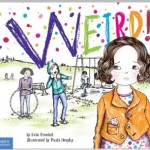
Image Source: Cover of Weird!: A Story About Dealing with Bullying in Schools by Erin Frankel, illustrated by Paula Heaphy. Reprinted with permission from Free Spirit Publishing / Teacher Created Materials. All rights reserved.
WEIRD! shares the story of a girl who is picked on by a bully in her third-grade class. Luisa begins to feel bad about herself and stops doing things she likes to do. She comes to realize that she is okay just as she is and that the more that the bully thinks she doesn’t care, the more she will be left alone and not picked on anymore. It comes with teaching notes at the end.
- WEIRD! is great to pair with conversations about what to say when peers ask about hearing devices or comment on having hearing loss.
Encouraging personal narrative expression!
In my travels across the US and Canada, speaking to professionals who work with children with hearing loss, a common theme arises: the challenge of inconsistent hearing aid use and the heavy feelings of not fitting in. A highly effective strategy used by educators is encouraging students to write down or illustrate their own personal experiences, challenges, and triumphs with hearing loss. Creating a personal story or journal helps children process these complex emotions and build a stronger sense of self-advocacy.
Utilizing creative storytelling or open discussion about peer experiences is excellent for sharing with older elementary students. This serves as a perfect lead-in to completing the SAC-A (Self Assessment of Communication – Adolescent) or the Secondary Survey (both of which can be done starting in grade 4) to dive deeper into their specific communication needs.
-
-
Top 10 Ways to Build Self-Esteem in Deaf & Hard-of-Hearing Students
- Encourage self-advocacy
- Celebrate strengths
- Normalize mistakes
- Support independence
- Teach communication repair strategies
- Connect with DHH peers
- Promote positive role models
- Foster social skills
- Encourage participation in activities
- Build future-focused goals
Frequently Asked Questions: Navigating Self-Esteem and Peer Acceptance
Why do deaf and hard-of-hearing students struggle with self-esteem during the tween and teen years?
Many students with hearing loss experience an intense desire to blend in with their mainstream peers. When a student is the only individual in their classroom or school using visible hearing technology (like hearing aids, cochlear implants, or a Roger FM receiver), it can amplify feelings of being “different.”
Social communication barriers, missing out on fast-paced peer jokes, and fatigue from constant listening can create a sense of social isolation that directly impacts overall confidence.
Can low self-esteem cause a student to stop wearing their hearing technology?
Yes. Technology rejection is almost always a social and emotional issue, not a mechanical or practical one.
Many tweens and teens will intentionally leave their hearing aids at home, turn off their processors, or “lose” their FM systems because they want to avoid looking different or standing out to peers. Adults must address the underlying social anxiety rather than simply repeating the academic benefits of amplification.
What are the warning signs that a student is struggling to fit in?
Because students often mask their social discomfort, parents and teachers should actively monitor for these specific behavioral indicators:
- Technology Avoidance: Intentionally hiding hearing devices under hair or hats, or claiming they “forgot” them.
- Passive Masking: Smiling and nodding along during conversations, even when it is clear they did not hear or comprehend the speaker.
- Academic Reticence: Refusing to request required accommodations or a classroom FM microphone because they are afraid of drawing attention to themselves.
- Social Withdrawal: Retreating from group activities, sports, or cafeteria dynamics to avoid the stress of complex listening environments.
How can adults support a student who feels isolated at school?
The transition from adult-driven support to true peer acceptance requires a coordinated effort:
| What Parents Can Do | What Teachers Can Do |
| Model positive disclosure scripts at home so the child can confidently explain their technology to curious peers. | Normalize acoustic accommodations for the entire classroom rather than singling out the DHH student. |
| Connect them with DHH peers through specialized camps, regional programs, or virtual student groups where hearing loss is normalized. | Incorporate subtle hearing loss awareness into general education lessons to build natural empathy among classmates. |
| Encourage non-academic strengths (art, athletics, coding) to build an identity that isn’t solely defined by their hearing loss. | Practice discrete communication habits, like passing a wireless microphone without making a grand announcement. |
How should a student be taught to handle teasing or awkward peer questions?
Instead of hoping that teasing won’t happen, educators and parents should use proactive role-playing. Teach the student short, confident, and punchy disclosure scripts that neutralize the awkwardness:
- For a curious classmate: “It’s a Roger microphone. It streams your voice directly to my ears so I can hear you over all this background noise. It’s basically like high-tech AirPods.”
- For an unkind comment: “Yeah, I wear hearing aids to hear better. It’s not a big deal.”
Why is a “DHH Peer Match” critical for identity development?
Research consistently shows that a student’s self-esteem rises dramatically when they interact with someone else who shares their life experience. Meeting other deaf or hard-of-hearing peers or introducing them to adult DHH role models removes the psychological burden of being the “only one.” It transforms their view of hearing technology from a medical deficit into a neutral, empowering tool for communication access.
-
-
- Additional Resources:
- You can find these assessment tools and checklists in the Informal Assessments for Parents, Students & Teachers:
-
- Children’s Peer Relationship Scale by Dr. Kris English
- SAC-A: Self-Assessment of Communication – Adolescent by Judy Elkayam
- SOAC-A: Significant Other Assessment of Communication: Adolescent by Judy Elkayam
- Checklist of Socio-Pragmatic Language Behaviors for Students with Sensory Impairment
- Various Social Skills Checklists
- Think About It Quiz – An informal assessment of self-concept for adolescents
- The Secondary School Survey (Available via Teacher Tools)
-
- Additional Resources:
-
Originally published: June 2017
Last Update: June 2026