Related Products
For Professionals
- Amplification
- Assessment of Student Skills, Challenges, Needs
- Early Childhood: Infants, Toddlers, Preschool
- Hearing Loss – Identification, Impact and Next Steps
- IDEA Law Summary Information
- Language and Speech Development Issues
- Legal Issues in Serving Children with Hearing Loss
- Listening (Auditory Skills) Development
- Planning to Meet Student Needs
- Self-Advocacy Skills for Students with Hearing Loss
- Self-Concept: How the Child with Hearing Loss Sees Himself
- Social Skills
- Speech Perception & Learning
Related Teacher Tools Takeout Items
The ULTIMATE Goal: Self-Determination for Deaf and Hard of Hearing Students
What is Self-Determination for Deaf and Hard-of-Hearing Students?

Image Credit: Image via Shutterstock / Vector Set (Concept of childhood strength and self-determination)
Self-determination is the ability to make choices, set goals, solve problems, and take responsibility for decisions. For deaf and hard-of-hearing students, self-determination includes understanding their hearing needs, communicating effectively, and advocating for accommodations that support success in school and life.
Simply put: Self-determination is a person’s ability to take actions toward self-chosen goals. It is about making things happen in your life.
The components of self-determination include:
|
|
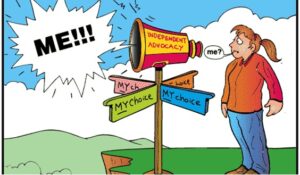
Image Credit: Source unknown / Educational Fair Use Archive.
Choice-making comes before decision-making and is the process of selecting from two or more alternatives. Decision-making is choosing the best option to reach one’s goals. Self-monitoring can include a student tracking or graphing their own progress while working toward goals. Shifting progress monitoring to the student can strengthen self-awareness, which is the ability to identify and understand one’s own needs, interests, strengths, limitations, and values. Throughout goal setting and attainment, self-reflection can increase self-awareness and the development of an internal locus of control, which is when a student understands that their actions cause results rather than attributing results to external factors. For example, a student with an external locus of control might say, “I didn’t do my homework because my brother was bothering me,” while a student with an internal locus of control might say, “I didn’t finish my homework because I was playing video games and started too late.”
Self-Determination Skills Checklist
As students develop self-determination, they gradually learn to take ownership of their decisions, goals, and accommodations. Consider whether the student can:
- Set personal goals
- Make decisions independently
- Explain their hearing loss
- Request accommodations
- Identify strengths and challenges
- Solve communication problems
- Participate in IEP meetings
- Evaluate progress toward goals
- Make informed choices
- Take responsibility for outcomes
What is the Difference Between Self-Advocacy and Self-Determination?
Self-advocacy, or the ability to advocate for one’s own needs and interests, is actually one component of self-determination. Think of self-determination as an umbrella term that includes all of the skills listed above; the individual takes actions or makes choices toward what they want.
| Core Concept | Internal Mindset | Functional Skill Output |
| Self-Advocacy | “I know what I need.” | Speaking up to request an interpreter, closed captions, or preferential seating. |
| Self-Determination | “I control my future.” | Setting an academic goal, evaluating a communication breakdown, and adjusting strategies independently. |
Why is Self-Determination Important for DHH Students?
One disadvantage of the educational setting shift from center-based options to full mainstreaming is that DHH children are often the only students with hearing loss in their classes or in the entire school, underscoring the need for self-advocacy skills. In 2017, 88.3% of students with hearing loss were included in general education classrooms for at least part of their school day compared with 57.8% in 1998.
In terms of the percentage of time students who are DHH are included in general education settings, 61.1% of students who are DHH were included at least 80% of their time in school in 2015, compared with 38.8% in 1998.
Self-advocacy is one component of self-determination and a facilitator of success in students who are deaf or hard of hearing (DHH). However, a five-year longitudinal study with 197 students who are DHH revealed that 41% of them received no training in self-advocacy from their teacher of the deaf.
Self-determination is a predictor of in-school and post-school success.
Self-determination is a predictor of in-school and post-school success and perceived quality of life for youth and young adults with disabilities. Despite the benefits, students with disabilities typically have insufficient self-determination skills, demonstrating the need for interventions to support the development of self-determination. However, there are significant educational attainment and employment gaps between individuals who are DHH and individuals who are typically hearing.
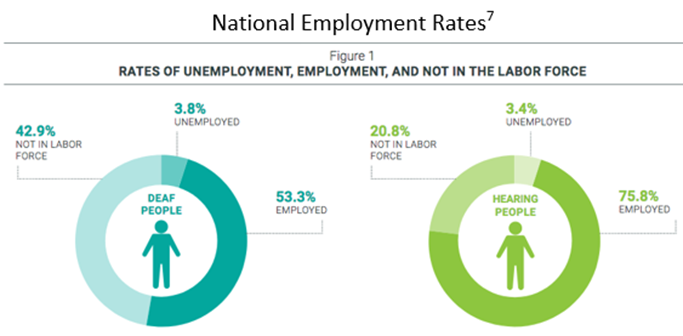
Rates of unemployment, employment, and labor force participation for deaf and hearing populations. Building core self-determination skills during school transitions can help close these foundational employment gaps. Source: National Deaf Center on Postsecondary Outcomes (NDC)
Working on developing self-determination skills with DHH students could address these academic and employment gaps and empower students to feel ownership of their own actions and lives.
The national standards for preparing teachers of students who are DHH, developed by the Council for Exceptional Children (CEC), now require teachers to know how to work on and assess self-determination skills with students. The National Deaf Center on Postsecondary Outcomes has also created a handout summarizing the significance of self-determination skills for deaf youth: HANDOUT.
Self-determination is a developmental process, not a one-time high school lesson.
- Choice-Making & Self-Awareness:
- Early Childhood / Elementary.
- Begin by offering controlled choices (e.g., choosing which ear to put the hearing aid on first) and teaching basic vocabulary to describe hearing technology.
- Problem-Solving & Goal Setting:
- Middle School / Pre-Teen.
- Transition toward the C.O.A.C.H. framework models. Teach the student to evaluate changing acoustic spaces, manage multiple teacher dynamics, and track their own academic progress.
- Self-Regulation & Full Autonomy:
- High School / Transition.
- Focus on civil rights under the Americans with Disabilities Act (ADA), active leadership roles in their own IEP meetings, and coordinating independently with outside support agencies.
Interventions
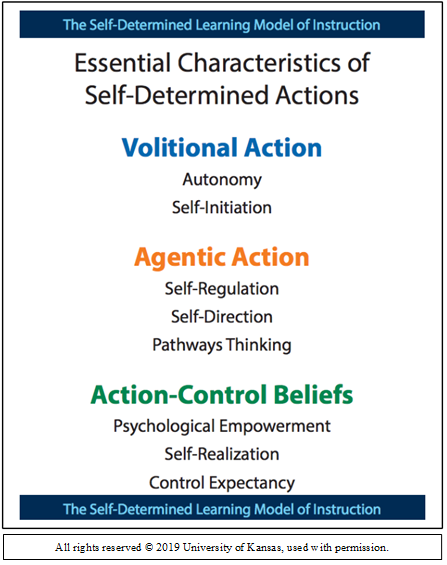
Image source: The Self-Determined Learning Model of Instruction (SDLMI), © 2019 University of Kansas Center on Developmental Disabilities. Used with permission.
Aim to use Evidence-Based Practices, as these practices are based on rigorous criteria. If you see the terms
best, recommended, or research-based practices, be wary as there are no established standards for these terms. To read about the quality of research for particular practices and interventions, visit the What Works Clearinghouse website, developed by the U.S. Department of Education Institute for Educational Sciences (IES).
The challenge within the field of Deaf Education is that there are few EBPs developed for or tested with students who are DHH due to the low incidence of hearing loss in children. Although most EBPs may have been designed for students with disabilities or all students in general, the evidence is stronger than using strategies that are simply suggested to you by another teacher.
SELF-DETERMINATION INTERVENTIONS:
The Self-Determined Learning Model of Instruction (SDLMI)
The SDLMI is an evidence-based intervention (EBP) that was designed for students with and without disabilities. It is an iterative goal-setting process through which students can set goals in any context (e.g., math and self-advocacy) and allows for the development of self-determination skills.
The SDLMI Teacher’s Guide is a resource that includes materials for teachers to use the SDLMI with students. It is geared toward middle and high school students, but you can adapt the language to the needs of your students. The SDLMI focuses on students setting their own goals and creates opportunities for students to revise goals as they learn what is and might not be achievable. The process is used repeatedly so students can then set goals more aligned with their strengths and needs when they have increased self-awareness. Find the SDLMI and other great resources here.

Image Source: Internet meme format / Promotional photograph of Adam Levine via public domain media.
Student Involvement in the IEP Process
When students increase involvement in their Individual Education Program (IEP) process and even lead it, this is an excellent opportunity to practice self-determination skills. Self-Advocacy Strategies: Student Involvement in the IEP Process: Developing Self-Determination.
You can utilize these resources to increase student involvement. Students who directed their own IEP process talked more and increased their leadership activities, positive perceptions about the meeting, and memory of their goals.
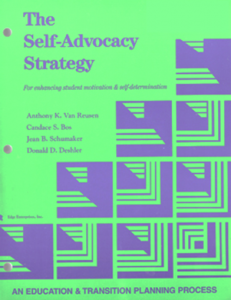
Image Source: Cover of The Self-Advocacy Strategy: For Enhancing Student Motivation & Self-Determination by Anthony K. Van Reusen, Candace S. Bos, Jean B. Schumaker, and Donald D. Deshler. Published by Edge Enterprises, Inc. Used for educational commentary.
The Self-Advocacy Strategy
The Self-Advocacy Strategy (available on Amazon) is an evidence-based practice (EBP) that was developed for students with disabilities to work on self-advocacy skills. Students who used the Self-Advocacy Strategy had 86% of goals they most valued in their IEPs compared with 13% of self-chosen goals in the IEPs of students who did not use the Self-Advocacy Strategy.
SELF-DETERMINATION INTERVENTIONS FOR STUDENTS WHO ARE DHH
Map It Transition Curriculum – Specific to DHH Students!

Image source: Described and Captioned Media Program (DCMP). Used with permission.
The Map It Curriculum is available through the Described and Captioned Media Program (DCMP) website (dcmp.org). There is a Map It: What Comes Next? Module with video vignettes in American Sign Language (ASL) and spoken English with transcripts. You can also access the
Map It Teacher Curriculum provides lesson plans and materials for educators.
Cover of Self-Advocacy for Students Who are Deaf or Hard of Hearing (Second Edition) by Dr. Kristina English, published by The University of Akron/NOAC. Used as a resource to foster self-determination and active communication skills.
Self-Advocacy For Students Who are Deaf or Hard of Hearing
Developed by Dr. Kristina English, the Self-Advocacy Strategy for Students who are Deaf or Hard of Hearing is a resource that teachers can use to differentiate between passive, active, and aggressive self-advocacy, helping students understand and practice appropriate self-advocacy skills. The chapters in their entirety can be found on the Supporting Success Self-Advocacy page.
Guide to Access Planning
The Guide to Access Planning (GAP) was developed by Drs. Carrie Spangler and Cheryl DeConde Johnson are available through the Phonak website. You can access the Personalized Transition Notebook, including the I CAN Self-Advocacy Checklist and the Audiology I CAN Self-Advocacy Checklist for teachers to complete.

Image Credit: Deafverse logo / National Deaf Center on Postsecondary Outcomes (nationaldeafcenter.org). Used for educational commentary.
Deafverse
Deafverse is an online game accessible in ASL available here through the National Deaf Center on Postsecondary Outcomes. The Deafverse Teacher Strategy Guide describes it as an interactive game inspired by the choose-your-own-adventure genre of storytelling. This game supports the development of self-advocacy skills as players respond to challenges and conflicts that are part of the deaf experience. These challenges and conflicts are often encountered throughout life, not just in the school environment; thus, the need for strong self-advocacy skills. The game is free and can be played on computers or mobile devices used at home, in the school environment, in transition programs, or even in vocational rehabilitation settings. The Deafverse Teacher Strategy Guide includes learning objectives on page 6.
Self-Determination as a Daily Practice
Skills such as writing, playing an instrument, or participating in a sport are strengthened through practice. The more time spent practicing, the more opportunities there are to develop skills. Self-determination skills are also fostered through practice. In addition to utilizing evidence-based interventions, adults can informally create opportunities for students to work on self-determination throughout the day, every day. This list of ideas can help infuse practice into typical daily activities in school and at home. Some parents shared they would never make it out the door in the morning if they had their child make choices or problem-solve for everything. We need to find the balance between providing some opportunities and maintaining an appropriate schedule.
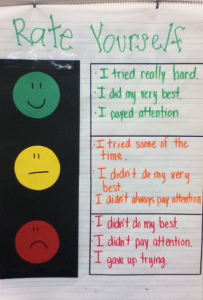
Classroom anchor chart example, via Supporting Success For Children With Hearing Loss.
Ages 3-5/Preschool
There are four areas of focus that are recommended in the early childhood years for practicing self-determination.
Areas of focus:
- Choice-making (e.g., clothing, choosing an activity or item)
- Problem solving (e.g., searching for a lost hearing aid, “You spilled your milk. What could you do to clean it up?”)
- Goal setting (e.g., potty training, self-feeding)
- Self-monitoring (e.g., rate yourself…)
- Self-awareness (e.g., discussing differences when using hearing equipment vs. not wearing it, discussing ASL signs they learned/which signs they know)
Elementary and Middle School
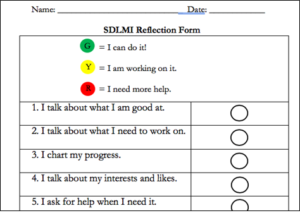
The SDLMI Reflection Form is used to assess student goal-setting skills. Image adapted from the Self-Determined Learning Model of Instruction (SDLMI), developed by the Kansas University Center on Developmental Disabilities. Used for promoting student self-determination.
Some ideas for daily or weekly practice of self-determination during the elementary school ages include:
-
-
- Choice making (e.g., choosing to wear FM/DMs by having the student collect data on their communication or academic performance when using the FM/DM compared with not wearing it, choosing extra-curricular activities such as sports)
- Problem solving (e.g., responding to negative peer behavior, time management, troubleshooting hearing equipment, resolving communication challenges)
- Goal setting using the student/child’s goals (e.g., academic subjects, practicing positive self-talk, self-advocacy, extra-curricular activities)
- Self-monitoring (e.g., students can use teacher-created assessment forms like in the figure to track their own progress; students graph their own progress, then reflect on changes to increase self-awareness, monitoring when to change hearing equipment batteries). Reflection form | Team Questionnaire | Elem Student Eval Tool
- Self-advocacy (e.g., asking for repetition or clarification, asking for captioned media)
- External versus internal locus of control (e.g., “My dog ate my hearing aid!” vs. “I should have put my hearing aid in a safer place. ”)
- Self-awareness (e.g., students reflect on their strengths and needs, write about interests and likes, discuss when they need help, learn about their hearing loss, communication implications, and hearing equipment)
-
-
High School
Self-determination should be practiced at all ages, but in middle and high school, you can start to discuss the future and transition out of high school with students. Here are some examples:
-
- Choice-making (e.g., choosing classes, choosing accommodations, choosing summer jobs or activities)
- Decision making (e.g., using transition resources to think about the future, making decisions about life after high school)
- Problem solving (e.g., addressing social challenges at school or home, working with teachers who have misperceptions about accommodations)
- Goal setting (e.g., planning for the future and using interventions like the SDLMI to actively take steps toward goals, self-advocacy, or other skill goals, grades, extracurriculars, planning activities with friends)
- Self-monitoring (e.g., tracking progress in school and at home toward their own goals)
- Self-advocacy (e.g., asking for repetition with friends or social settings, contacting the disability resource center at a future college to inquire about and plan accommodations)
- Internal locus of control (e.g., connecting academic performance with daily habits/growth mindset rather than thinking they are not intelligent or something else is preventing success; accepting responsibility for actions outside of school)
- Self-awareness (e.g., understanding hearing loss, equipment/troubleshooting, and communication needs; understanding their strengths, needs, and interests)
-
-
-
Cover of C.O.A.C.H. – Self-Advocacy & Transition Skills for Secondary Students Who Are Deaf or Hard of Hearing by Lynne H. Price. Courtesy of Supporting Success for Children with Hearing Loss.
-
COACH Self-Advocacy & Transition Skills for Secondary Students with Hearing Loss who are Deaf or Hard of Hearing is a guide to discussing and practicing critical problem-solving skills for middle and high school students.
What if my student/child does not respond when I provide opportunities?
With any self-determination skill, consider using an “I do, we do, you do” format. First, model the skill, then practice the skill together, and finally, the child or student tries the skill independently. For example, if you have a preschool student who will not make a choice between two or three activities when you provide the chance to work on choice-making skills, start by modeling. It could look like this:
Modeling Choice-Making (“I do”):
-
-
-
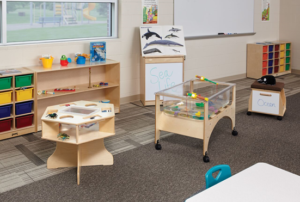
Image Credit: Image courtesy of Jonti-Craft, Inc.
Teacher: “Which center activity would you like to try first?”
- (Student shrugs shoulders or doesn’t respond after providing wait time.)
- Teacher: “Hmm, we have the sand and water center or the music center over here, or you could choose the block center.”
- (Student still does not indicate a choice when provided with time to think.)
- Teacher: Model choice-making by saying, “Let’s see, if I feel like getting wet and messy, I might choose the sand and water center. Or, if I want to explore sounds, I might try the music center. Or, if I love to build things, I would try the block center.”
- (Student is still not making a choice.)
- Teacher: “Well, I like to see what happens when I stack blocks. There are so many cool things we can do with them. Let’s try that together to start!”
-
-
Scaffolding Choice-Making (“We do”)
-
-
- Teacher: “Good morning! Which center would you like to try?”
- (Student does not make a choice.)
- Teacher: “Do you feel like getting wet and messy, playing with sound and instruments, or building things?”
- Student: “Play in the water.”
- Teacher: “Okay, great! It sounds like you want to start with the water and sand center. Let’s check it out.”
- (Student and teacher go to the center together.)
-
Practicing Choice-Making (“You do”)
-
-
- Teacher: “Which center would you like to try?”
- (Student walks over to a center and begins exploring).
- If the student/child can easily make a choice in one context, provide opportunities for choice-making in different contexts (e.g., choosing a book, choosing a color, choosing whether to sit on a pillow or the floor).
-
Friendships and Social Opportunities

Photo courtesy of Congregational Church of Topsfield Mission Trip / Wicked Local.
Self-determination and friendships are positively correlated in teens who are deaf or hard of hearing (DHH). Although we don’t know if one increases the other, we know that students with more friendships and higher-quality friendships have higher self-determination scores. Consider how you can encourage and get students and children involved with extra-curricular activities, social opportunities, and summer camps where they can develop friendships. Specifically, seek opportunities where students can meet other kids who are deaf or hard of hearing. In general education settings, students who are DHH are often the only students with hearing loss in their class or school. Thus, they face challenges related to their hearing loss every day.
Connecting with peers who understand these experiences is crucial for reducing feelings of isolation and increasing social support.
SELF-DETERMINATION AND IEP GOALS
Formal Assessment
The Self-Determination Inventory (SDI)

Image courtesy of the University of Kansas – Schiefelbusch Institute for Life Span Studies / Center on Developmental Disabilities. Used with permission.
The Self-Determination Inventory is an online assessment that was developed by a team at the University of Kansas (KU). If you visit the website, you may use the assessment with individual students and view their scores at the end, along with a report explaining the scores. If you’d like to use it for many students and for progress to be tracked online, you can contact KU to set up an account to manage your student data. The SDI allows for progress monitoring. You can use it as an assessment at the beginning of the school year to write IEP goals, multiple times during the year to track progress, and then determine if annual IEP goals were met. There is a student-report version (SDI: SR) where students rate their own skills, as well as a parent/teacher report (SDI: PTR) where parents and teachers can rate student skills and compare them to their self-ratings. The SDI is available in American Sign Language, written English, and Spanish and includes accessibility features and in-text definitions for vocabulary terms.
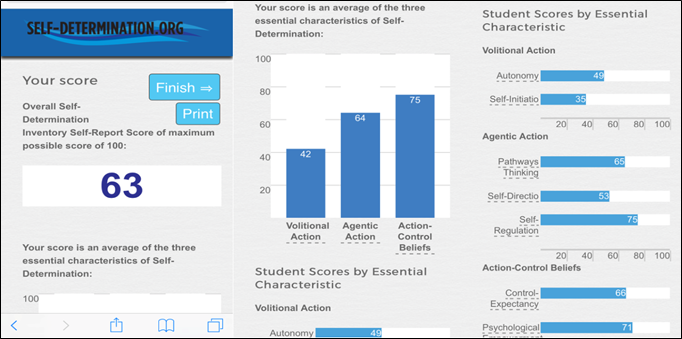
Image source: © 2020 Kansas University Center on Developmental Disabilities. Used with permission.
The following screenshot shows what the score report looks like:
Self-Advocacy Assessments
These assessments were developed specifically for students who are deaf or hard of hearing. Many items are geared toward students who use hearing technology, but you can adapt the assessments to the needs of the students with whom you work. Examples include the I CAN Self-Advocacy Checklist and the Audiology I CAN Self-Advocacy Checklist for teachers to complete.
Informal Assessments
Other self-determination assessments can be found at imdetermined.org.
If you can’t find a resource that fits the needs of the students with whom you work, you can make adaptations or create your own. Here are preschool and elementary self-determination assessments created by teachers: Example | Reflection form | Team Questionnaire | Elem Student Eval Tool
SAMPLE IEP GOALS
You can find excellent examples of self-determination IEP goals and objectives for students with disabilities online. Here are some sample self-determination goals that are geared more toward students who are DHH.
IEP Annual Goal Example 1 (self-awareness and self-advocacy):
I will be able to explain my hearing loss, communication needs, and hearing equipment by the May 2021 IEP meeting.
IEP Objectives
-
-
- 1.1 I will demonstrate my understanding of hearing and my hearing loss by being able to describe all components in the “Understanding hearing and hearing loss” section of the I CAN Self-Advocacy Checklist.
- 1.2 I will describe my communication needs, including what I need from other people in writing, speaking/signing, and 8/10 self-advocacy opportunities when meeting new people at the beginning of the spring semester.
- 1.3 I will be able to describe my hearing equipment, including every component of the “Use of individual amplification devices” and “Use of assistive technologies” sections of the I CAN Self-Advocacy Checklist.
-
IEP Annual Goal Example 2 (goal setting):
I will increase my self-determination skills by 10% by the May 2021 IEP meeting, as determined by the Self-Determination Inventory.
IEP Objectives
-
-
- 2.1 I will use the Self-Determined Learning Model of Instruction (SDLMI) on a weekly basis to identify and work toward my own goals throughout the school year.
- 2.2 I will increase my Self-Determination Inventory Score by an average of 2.5% per quarter by the end of the school year as measured by assessments at the beginning of each quarter and at the end of the school year.
- 2.3 At the end of the school year, I will be able to identify ten goals I set for myself during the school year, including a reflection on my goal attainment, what I learned using the SDLMI, my strengths, and goals for the next school year.
-
SAMPLE DATA COLLECTION AND PROGRESS MONITORING
IEP Goal Example 1:
-
-
- Initial Assessment to Determine Baseline
- 1.1 and 1.3 Use the I CAN Self-Advocacy Checklist to determine skills at the start of the school year.
- 1.2 Ask the student to write and/or speak or sign their communication needs to determine baseline skills.
- Progress Monitoring Assessment (Determine the frequency)
- 1.1 and 1.3 Revisit the I CAN Self-Advocacy Checklist once every quarter with the student to help them identify their progress.
- 1.2 Create an observation checklist and observe the student during 10 meetings with new teachers, coaches, and/or peers, and determine if the student can describe their communication needs to each person.
- Final Assessment to Determine if the IEP Goal Was Met
- 1.1 and 1.3 Use the I CAN Self-Advocacy Checklist at the end of the school year with the student to help them identify if they met their goal.
- 1.2 Using the same observation checklist, repeat the observation of the student during 10 meetings with new teachers, coaches, and/or peers and determine if the student can describe their communication needs to each person.
- Initial Assessment to Determine Baseline
-
IEP Goal Example 2:
-
-
- Initial Assessment to Determine Baseline
- 2.1 N/A
- 2.2 Use the Self-Determination Inventory at the beginning of the school year to determine baseline self-determination skills.
- 2.3 Use a written (or spoken or signed) student reflection to assess self-awareness of strengths and needs at the beginning of the school year.
- Progress Monitoring Assessment (Determine the frequency)
- 2.1 Create a weekly checklist to determine if the student worked through the three phases of the SDLMI every week of the school year. If there were some weeks when phase three was not reached and carried to the following week, but progress was met, this is okay.
- 2.2 Use the Self-Determination Inventory once each quarter to measure progress.
- 2.3 Use a mid-year assessment, asking the student to reflect about five goals.
- Final Assessment to Determine if the IEP Goal Was Met
- 2.1 Use the weekly checklist to determine if the SDLMI was used each week.
- 2.2 Use the Self-Determination Inventory at the end of the school year to measure growth from the beginning of the year to the end of the year.
- 2.3 Ask the student to write a self-reflection about ten goals from the school year, including strengths, lessons learned, and goals for next year.
- Initial Assessment to Determine Baseline
-
How Self-Determination Supports Transition Success
Self-determination is one of the strongest predictors of successful outcomes after high school. Students who understand themselves, make informed decisions, and advocate for their needs are often better prepared for the challenges of adulthood. Self-determination helps students:
- Prepare for College. Students learn to request accommodations, communicate with disability services, and take responsibility for their learning.
- Enter the Workforce. Students gain confidence discussing communication needs and workplace accommodations with employers.
- Manage Accommodations. Students learn when accommodations are needed and how to request them independently.
- Communicate Effectively. Students become more comfortable explaining their hearing needs and resolving communication barriers.
- Develop Independence. Students learn decision-making, problem-solving, and personal responsibility skills.
- Achieve Postsecondary Goals. Students are better prepared to pursue education, employment, and community participation opportunities.
Top 10 Self-Determination Skills for Deaf and Hard-of-Hearing Students
Self-determination develops through practice and experience. The following skills help students become confident, independent, and successful in school and beyond.
- Goal Setting
- Decision-Making
- Self-Awareness
- Self-Advocacy
- Problem-Solving
- Communication Skills
- Independent Thinking
- Responsibility
- Confidence Building
- Future Planning
Frequently Asked Questions about Self-Determination for Deaf & Hard-of-Hearing Students
What is self-determination in deaf education?
Self-Determination is the broader ability to make choices, set goals, solve problems, and take direct action to achieve desired outcomes in life. Instead of relying on parents or teachers to arrange their world, a student with strong self-determination becomes the primary actor and decision-maker in their own success.
How is self-determination different from self-advocacy?
While often used interchangeably, they are distinct milestones on the road to independence:
- Self-Advocacy is the functional act of speaking up for your immediate needs, rights, and required accommodations (e.g., asking a teacher to wear an FM microphone transmitter).
- Self-Determination is the overarching internal psychological drive that encompasses goal setting, self-regulation, independent choice-making, and taking full responsibility for the outcomes.
What specific skills build self-determination in students with hearing loss?
To move beyond basic paperwork compliance, an effective K-12 curriculum should explicitly target these seven core behavior pillars:
- Goal Setting: Designing measurable academic and personal targets.
- Problem-Solving: Identifying unexpected communication barriers and adjusting.
- Decision-Making: Evaluating the long-term consequences of different choices.
- Self-Awareness: Deeply understanding one’s own audiological strengths and limitations.
- Self-Regulation: Managing schedules, hearing technology maintenance, and study habits.
- Accommodation Requests: Independently disclosing a disability and arranging access.
- IEP Leadership: Actively preparing for and directing their own educational meetings.
How can families and schools collaborate to teach these skills?
- At Home: Families can support autonomy by stepping back from problem-solving too quickly. Allow your teen to make age-appropriate decisions, practice scheduling their own audiology appointments, and handle minor communication breakdowns independently.
- In the Classroom: Teachers can move away from generic worksheets and instead utilize evidence-based tools like the TAGG (Transition Assessment and Goal Generator) or the Audiology Self-Advocacy Checklist (ASAC) to systematically track real-world behavioral growth.
What is the difference between high school and college accommodations?
The shift from high school to secondary education represents a massive legal change that catches many families off guard:
| Feature / Responsibility | High School (IDEA / K-12) | College & University (ADA / Section 504) |
| Legal Mandate | Success-driven: The school must find the student, assess needs, and provide support. | Access-driven: The institution must protect against discrimination but does not guarantee success. |
| The Burden of Proof | The IEP/504 team identifies disabilities and designs accommodations. | The student must self-disclose, provide recent audiological documentation, and request accommodations. |
| Technology Delivery | The district provides, maintains, and troubleshoots FM/DM Roger systems. | The student must manage their personal devices; the college provides systemic access (e.g., CART or interpreters). |
What role does Vocational Rehabilitation (VR) play in self-determination?
State Vocational Rehabilitation agencies act as a critical real-world testing ground for a student’s autonomy. Because VR services require the young adult, not the parent, to complete interviews, track intake documentation, and justify their employment or training goals, navigating the VR system serves as a powerful, practical application of self-determination before high school graduation.
References
-
-
- Wehmeyer, M. L. (1995). The Arc’s Self-Determination Scale: Procedural guidelines. Washington, DC: The Arc of the United States.
- Reed, S., Antia, S. D., & Kreimeyer, K. H. (2008). Academic status of deaf and hard-of-hearing students in public schools: Student, home, and service facilitators and detractors. Journal of Deaf Studies and Deaf Education, 13(4), 485-502. doi:1093/deafed/enn006
- Antia, S. D., & Rivera, M. C. (2016). Instruction and service time decisions: Itinerant services to deaf and hard-of-hearing students. Journal of Deaf Studies and Deaf Education, 21(3), 293-302. doi:10.1093/deafed/enw032
- Mazzotti, V., Rowe, D., Sinclair, J., Poppen, M., Woods, W., & Shearer, M. (2016). Predictors of post-school success: A systematic review of NLTS2 secondary analyses. Career Development and Transition for Exceptional Individuals, 39(4), 196-215.
- McDougall, J., Evans, J., & Baldwin, P. (2010). The importance of self-determination to perceived quality of life for youth and young adults with chronic conditions and disabilities. Remedial and Special Education,
31(4), 252-260. doi:1177/0741932509355989 - Shogren, K. A., Kennedy, W., Dowsett, C., Garnier Villarreal, M., & Little, T. D. (2014). Exploring essential characteristics of self-determination for diverse students using data from NLTS2. Career Development and Transition for Exceptional Individuals, 37(3), 168-176. doi:10.1177/2165143413486927
- Garberoglio, C.L., Palmer, J.L., Cawthon, S., & Sales, A. (2019). Deaf People and Educational Attainment in the United States: 2019. Washington, DC: U.S. Department of Education, Office of Special Education Programs, National Deaf Center on Postsecondary Outcomes.
- Garberoglio, C. L., Cawthon, S., & Sales, A. (2017). Deaf people and educational attainment in the United States: 2017. Washington, DC: US Department of Education, Office of Special Education Programs, National Deaf Center on Postsecondary Outcomes.
- Council for Exceptional Children. (2018). Initial specialty set: Deaf and hard of hearing.
- Cook, B. G., & Cook, S. C. (2013). Unraveling evidence-based practices in special education. The Journal of Special Education, 47(2), 71-82.
- Institute for Educational Sciences (2019). What works clearinghouse: Select topics to find what works based on evidence.
- Shogren, K. A., Raley, S. K., Burke, K. M., & Wehmeyer, M. L. (2019). The Self-Determined Learning Model of Instruction Teacher’s Guide. Lawrence, KS: Kansas University Center on Developmental Disabilities.
- Martin, J. E., Van Dycke, J. L., Christensen, W. R., Greene, B. A., Gardner, J. E., & Lovett, D. L. (2006). Increasing student participation in IEP meetings: Establishing the self-directed IEP as an evidence-based practice. Exceptional Children, 72(3), 299-316.
- Mueller, T. G. (2009). IEP facilitation: A promising approach to resolving conflicts between families and schools. Teaching Exceptional Children, 41(3), 60-67.
- Van Reusen, A. K., Bos, C. S., Schumaker, J. B., & Deshler, D. D. (2002). The self-advocacy strategy for enhancing student motivation and self-determination. Lawrence, KS: Edge Enterprises.
- Lancaster, P. E., Schumaker, J. B., & Deshler, D. D. (2002). The development and validation of an interactive hypermedia program for teaching a self-advocacy strategy to students with disabilities.
Learning Disability Quarterly, 25, 277-302. - English, K. (2012). Self-advocacy for students who are deaf or hard of hearing: Second edition. Akron, OH: The University of Akron/NOAC.
- Palmer, S. B. (2011). Advocating for children’s social emotional well-being in educational settings: Tips for families. Impact Feature issue on supporting the social well-being of children and youth with disabilities.
Impact, 24, 5. - Millen, K., Dorn, B., & Luckner, J. L. (2019). Friendships and self-determination among students who are deaf or hard of hearing. American Annals of the Deaf, 163(5), 576-595. doi:10.1353/aad.2019.0004
- U.S. Department of Education. (2019). Digest of Education Statistics, 2017.
- U.S. Department of Education. (2000). Digest of Education Statistics, 2000.
-
April 2020 © Supporting Success for Children with Hearing Loss. Author: Kaitlyn Millen, M.Ed., teacher of students who are deaf/hard of hearing, and PhD candidate at the University of Northern Colorado.
Originally published: March 2020
Last update: June 2026