Related Products
For Parents
Related Teacher Tools Takeout Items
Self-Advocacy Skills Development for Full Classroom Participation
Self-advocacy skills development is essential for students with hearing loss because it helps them ask for support, explain their needs, and participate more fully in the classroom. When students learn these skills early, they are better prepared for school success and future independence.
Self-Advocacy Skill Development is Required for Full Participation in the Classroom
The ‘bread and butter’ of itinerant support to students with hearing loss is often considered to be ensuring communication access, supporting language development, and training self-advocacy skills. While access relates to ADA requirements and supporting language is linked to academics, training in self-advocacy is too often considered to be non-academic and therefore not necessary. One thing we know for sure about our students is that they will miss or misunderstand more communication than their peers. This is the basis for ongoing language and vocabulary issues and underlies the need for self-advocacy. Access and teacher accommodations cannot close all ongoing speech perception or communication gaps. It truly is necessary to teach self-advocacy skills to enable students to fully participate in the classroom and act appropriately when they know they have not fully received or understood information.
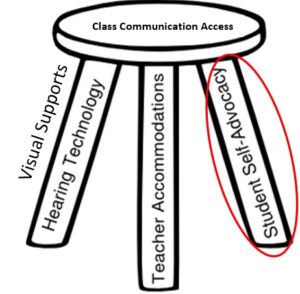
The Class Communication Access model relies heavily on targeted self-advocacy skills development to ensure a student’s full participation in the classroom. Image courtesy of Supporting Success for Children with Hearing Loss.
If a student who has low vision were continually knocking into people, desks, and classroom walls due to the inability to clearly see everything, a vision specialist would likely be called in to assist the student in developing appropriate orientation and mobility skills. A student with hearing loss often incompletely hears, misses spoken information, or misunderstands what is said. Self-advocacy training is to a student with hearing loss what orientation and mobility training is to a student with visual impairment.
Students do not know what they didn’t hear because they didn’t hear it, yet they are held accountable for receiving and fully understanding this information.
Full participation in the classroom requires that a student recognize when a communication breakdown occurs and self-advocate for their listening and learning needs. Students who are deaf or hard of hearing must have the knowledge and skills to access accommodations and support in any setting and as an integral part of an independent adulthood. Ideally, students would have instruction in self-advocacy from preschool through grade 4 (about age 10). As they reach the tween and teen years, focus should change to supporting the student’s ability to problem-solve communication issues as part of their self-determination of future goals.
Self-Advocacy Skills Development Students Need to Learn
Components of Self-Advocacy: The following are basic questions that students with hearing loss typically require instruction in so that they can understand their hearing needs and respond appropriately.
Self-Advocacy
- What does it mean to have a hearing loss?
- Why do I have problems understanding (related to hearing loss and
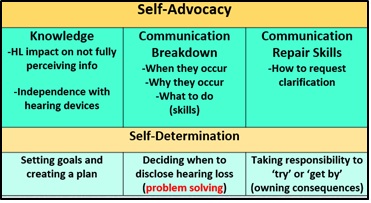
Image courtesy of Supporting Success for Children with Hearing Loss.
language issues)?
- How does my hearing loss affect me (school, socially)?
- When do I have problems understanding what people say?
- How important are my hearing devices?
- How do I know when my hearing devices are not working?
- What should I do when they are not working?
- What can I do when I know I have not heard what was said (specific self-advocacy & communication repair strategies)?
Self-Determination
- How much am I willing to have the hearing loss impact how well I do in school (planning/future goals)?
- When is it critical for me to disclose my hearing loss (problem-solving)?
- What are my legal rights to access, supports, and services?
From the US Office of Civil Rights:
We need to encourage students to understand their disability.
- They need to know the functional limitations that result from their disability.
- Understand their strengths and weaknesses. Be able to explain their disability to others.
- Be able to discuss their difficulties in the past and what has helped them overcome such problems.
- This should include specific adjustments or strategies that might work in specific situations.
- They must practice explaining their disability, as well as why they need certain accommodations, supports, or services.
U.S. Department of Education, Office for Civil Rights, Transition of Students With Disabilities to Postsecondary Education: A Guide for High School Educators, Washington, D.C., 2007
Teaching Self-Advocacy Skills Development Through Everyday Experiences

Image Credit: VectorInspiration / Dreamstime
He does not know what he did not hear. This reality underlies the requirement to teach self-advocacy, specifically teaching the student about what he does hear, does not hear, and under what conditions and how to use situational awareness to recognize when he likely missed information.
Some knowledge of hearing loss teaching and assessment resources:
- Advocacy in Action Self-Advocacy Curriculum
- Audiology Self-Advocacy Checklist – Elementary School, Middle School, High School
- Building Skills for Success in the Fast-Paced Classroom
- ELFLing
- Monkey Talk Self-Advocacy Game
- Phonak Guide to Access Planning
- Recorded Functional Listening Evaluation Using Sentences (FLE)
- Steps to Success: Sequence of Skills for Students who are Deaf/Hard of Hearing
Teaching Hearing Device Use and Troubleshooting
Some knowledge of hearing device use, teaching, and assessment resources:
- Advocacy in Action Self-Advocacy Curriculum
- Building Skills for Independence in the Mainstream
- SEAM – Student Expectations for Advocacy & Monitoring Listening and Hearing Technology (PDF)
- Steps to Success: Scope and Sequence of Skills for Students who are Deaf/Hard of Hearing
Teaching Self-Advocacy Strategies
Some knowledge of self-advocacy skills, teaching, and assessment resources:
- Advocacy in Action Self-Advocacy Curriculum
- Building Skills for Independence in the Mainstream
- Building Skills for Success in the Fast-Paced Classroom
- COACH: Self-Advocacy & Transition Skills for Secondary Students who are Deaf/Hard of Hearing
- Guide to Self-Advocacy Skill Development: Suggestions for Sequence of Skill Attainment (PDF)
- Monkey Talk Self-Advocacy Game
- Phonak Guide to Access Planning
- SCRIPT 2nd Ed: Student Communication Repair Inventory & Practical Training
- Steps to Success: Scope and Sequence of Skills for Students who are Deaf/Hard of Hearing
- What’s the Problem Game
Self-Advocacy and IEP Goals
Success in the general education setting requires an ongoing instruction program in self-advocacy skills needs, including hearing aid independence, to be a part of the services provided to students with hearing loss as part of their IEP or 504 Plan.
Frequently Asked Questions: Self-Advocacy Skills Development for Classroom Participation
What are self-advocacy skills for students with hearing loss?
Self-advocacy skills are the specific, teachable abilities that enable deaf and hard-of-hearing (DHH) students to understand their hearing needs, recognize when a communication breakdown occurs, and independently ask for help or accommodations.
The Core Reality: Access and accommodations alone cannot close 100% of speech perception gaps. Because a student cannot know what they didn’t hear simply because they didn’t hear it, they must be explicitly taught how to read situational cues to realize they’ve missed information.
Why is self-advocacy training considered an educational requirement rather than an “extra”?
Many school teams mistakenly view self-advocacy as a non-academic social skill. In reality, it is a foundational prerequisite for classroom access.
| The Educational Paradigm
|
The Vision Impairment Analogy
|
The Hearing Loss Reality
|
| The Challenge | A low-vision student physically bumping into walls or desks due to a lack of visual clarity.
|
A DHH student missing spoken instruction or misunderstanding peer conversations due to acoustic gaps.
|
| The Instructional Fix | Specialized Orientation and Mobility (O&M) training to safely navigate physical spaces. | Specialized self-advocacy training to systematically navigate dynamic auditory spaces. |
What core components must a self-advocacy curriculum cover?
According to specialized DHH frameworks, comprehensive instruction must teach students to confidently answer these fundamental questions:
- What does it mean to have a hearing loss, and how does it functionally affect me in school and social settings?
- When and why do I experience problems understanding speech?
- How do I recognize when my hearing devices or FM/DM systems are malfunctioning, and what steps do I take to fix them?
- What specific communication repair strategies do I use when I realize I have missed spoken information?
At what age should self-advocacy instruction begin on an IEP?
Instruction should follow a systematic, developmental timeline throughout a student’s K-12 journey:
- Foundational Skill Building:
- Preschool to Grade 4 (Ages 3-10).
- Focus heavily on direct instruction regarding device independence, naming hearing technology components, and recognizing basic communication breakdowns.
- Situational Problem-Solving:
- Middle School & Tweens (Ages 11-13).
- Focus shifts to active, situational problem-solving. Students practice explaining their functional limitations, strengths, and weaknesses to a rotating roster of mainstream teachers.
- Self-Determination & Transition Planning:
- High School & Beyond (Ages 14+).
- Focus pivots to long-term self-determination and postsecondary transition planning. Students master their legal rights under the ADA/Section 504 and practice formal accommodation disclosure for college or workplace settings.
Additional Resources:
Self-Advocacy Apps
Self-Advocacy as a Stand-Alone Service
Self-Advocacy Skills for Students with Hearing Loss
The Ultimate Goal: Self-Determination
Teen Transition: A Necessary Part of Future Success
Don’t Wait, Self-Advocate! Self-Advocacy for Students with Hearing Loss
Download the original article.
Originally Published: Dec. 2018
Last update: June 2026